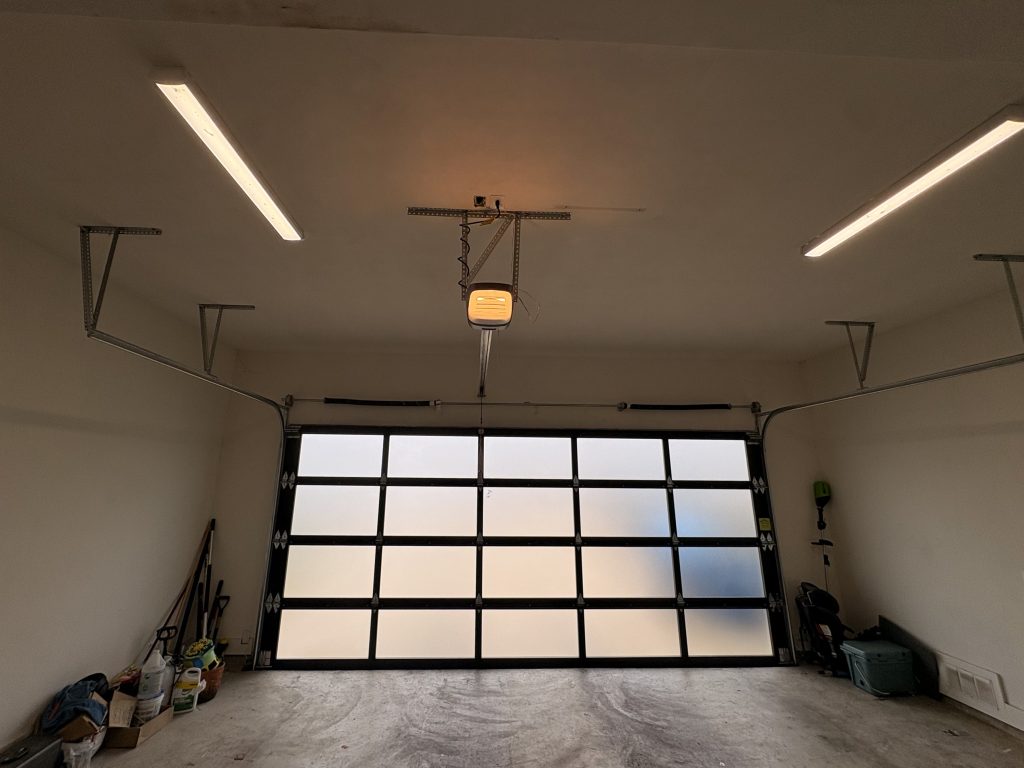
A full-view glass garage door strains your opener primarily because tempered glass panels create substantial deadweight compared to standard steel doors. If torsion springs are slightly under-wound, fatigued, or improperly sized for the heavy glass assembly, the electric opener must pull excessive weight rather than merely guiding balanced movement.
SAFETY WARNING: Full-view glass garage doors weigh between 300 and 600 pounds or more, counterbalanced by extremely hazardous high-tension torsion springs. Never attempt to adjust, wind, or release torsion springs, bottom brackets, or lifting cables on your own. A sudden release of stored tension or panel collapse can cause catastrophic impact injuries or fatal blunt-force trauma. Always contact a certified garage door professional for adjustments.
The Hidden Weight of Modern Full-View Glass Doors
Contemporary aluminum full-view garage doors provide striking aesthetics and abundant natural lighting. However, many homeowners do not realize that multiple lites of thick, tempered frosted or insulated glass dramatically increase the overall curb weight of the door curtain. Unlike standard hollow steel sections that weigh roughly 130 to 180 pounds across a double-car span, a full-view aluminum frame equipped with full glass panes can easily top 400 to 550 pounds.
An automatic garage door opener is an electro-mechanical drive meant to initiate and guide motion—it is not designed to bear hundreds of pounds of deadweight. The heavy lifting must be performed entirely by properly calibrated torsion springs.
Common Reasons Your Opener Is Struggling
1. Mismatched or Fatigued Torsion Springs
Torsion springs are engineered using precise mathematical formulas involving wire diameter, inner spring diameter, and active coil length. When glass doors are fitted with standard residential springs—or when aging springs lose their torsional foot-pounds of lift—the door becomes bottom-heavy. The opener motor will hum, groan, or hesitate during the initial lift phase off the floor.
2. High Ceiling Drop Bracket Flexing
Modern homes frequently feature high ceilings with suspended horizontal tracks secured by long perforated angle iron drops. If these down-hangers lack diagonal sway bracing, the immense upward torque of dragging a heavy glass curtain can twist the track framing out of square, causing the rollers to bind in the radius curve.
3. Inadequate Motor Horsepower Rating
Standard 1/2-horsepower residential openers frequently lack the continuous starting torque required to smoothly move heavy glass sections. Upgrading to a heavy-duty 3/4 HP or 1-1/4 HP equivalent DC belt-drive or direct wall-mount jackshaft system is often required to handle the inertia.
Causes vs. Solutions for Glass Door Strain
| Observed Issue | Root Technical Cause | Professional Solution |
|---|---|---|
| Opener hums loudly and reverses right after lifting. | Excessive deadweight triggering the opener’s safety force limits. | Technician weighs door and installs calibrated high-cycle torsion springs. |
| Trolley rail bows upwards during initial lift. | Inadequate door balance forcing opener rail to bear vertical load. | Spring tension adjustment and installation of an opener reinforcement bracket. |
| Door jerks or shudders through track curves. | Heavy panel rollers binding inside unbraced or misaligned tracks. | Realigning track geometry and installing sealed steel-ball nylon rollers. |
Safe Troubleshooting Checks for Homeowners
If you suspect your glass garage door is straining its drive system, conduct these observational checks without touching any high-tension hardware:
- Examine the Motor Rail: Watch the central steel rail as the door begins its ascent. If the rail bows significantly upward or downward, the door is severely out of balance.
- Listen for Roller Screech: Listen for grinding sounds along the curves where the panels flex horizontally overhead.
- Inspect Hanger Rigidity: Look up at the ceiling punch-angle drops; excessive swaying indicates the need for cross-bracing.
- Perform a Professional Balance Test: Disconnect the opener only when the door is fully closed, and have a trained technician verify whether the door floats neutrally at waist height.