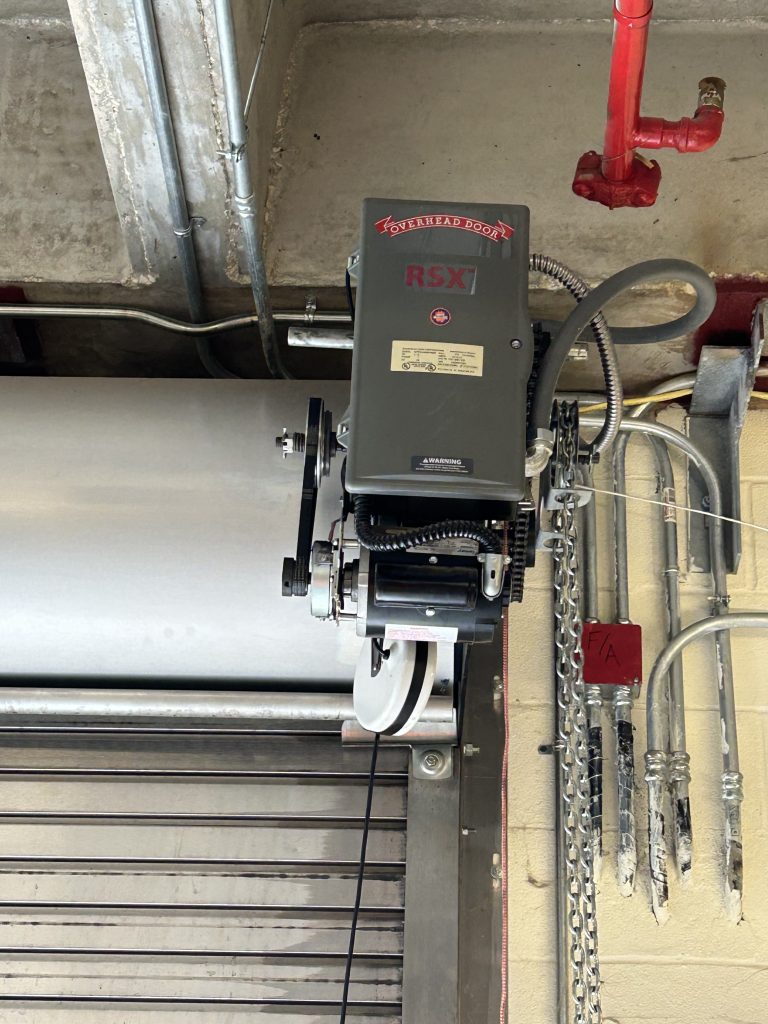
If your commercial rolling fire door will not open after a fire alarm test, the operator’s internal mechanical release has disengaged the motor drive to ensure gravity closure during an emergency. To restore power operation, the mechanical drop-release governor, fusible links, and electrical interlocks must be professionally inspected, re-tensioned, and reset.
SAFETY WARNING: Commercial rolling fire doors rely on extreme spring torque and heavy multi-slat steel curtains to force gravity closure during an emergency. Never attempt to rewind counterbalance springs, pry open disengaged curtains, or tamper with tensioned release arms. Improper handling can cause uncontrolled free-fall, severe crushing injuries, and forfeiture of building life-safety certification.
Understanding the Post-Alarm Disconnect Mechanism
Commercial fire-rated roll-up doors—such as those driven by heavy-duty Overhead Door RSX operators—are engineered with fail-safe life-safety mechanisms. When a facility conducts an alarm test or an actual alarm occurs, a signal sent to the fire release module (often housed in an adjacent fire alarm junction box) activates a magnetic or solenoid release.
This action physically decouples the electric motor drive from the door’s barrel shaft, allowing the counterbalance springs and gravity governor to drop the steel curtain automatically. Once this failsafe is activated, standard push-button stations and remotes are intentionally rendered inactive until a certified mechanical and electrical reset is executed.
Primary Reasons Your Rolling Fire Door Won’t Reset
1. The Mechanical Drop-Release Governor Has Not Been Relatched
During a drop test, the mechanical clutch disengages and the speed governor latches open to regulate drop speed. Even if power returns to the motor, the drive shaft cannot turn the curtain barrel until the mechanical release bracket and chain are manually re-cocked and pinned into their operating positions.
2. Tripped Fusible Links or Blown Thermal Sensors
If physical heat was applied during testing or if the mechanical tension line lost slack, the fusible links may have separated. Without uninterrupted cable or sash chain tension holding the trip lever closed, the emergency release stays engaged.
3. Un-Cleared Fire Alarm Panel Interlocks
Modern commercial operators integrate directly with building management systems (BMS). If the master alarm panel still holds a supervisory trouble code or active alarm relay, the RSX operator’s internal logic board will suppress all directional commands to prevent the door from reopening prematurely during an emergency.
Troubleshooting Checklist for Facility Managers
Before calling a licensed commercial door technician, building personnel should verify non-hazardous external conditions:
- Verify Alarm System Clear: Confirm on the main fire alarm panel that the specific zone loop is reset and no active alarm relays remain energized.
- Inspect Electrical Power: Check the dedicated disconnect box and circuit breaker feeding the commercial operator to ensure a power surge did not trip the breaker.
- Look for Visual Mechanical Disconnects: Observe if the sash chain, manual drop cable, or operator drive chain is visibly slack or resting against stop limits without touching tensioned components.
- Check Guide Tracks: Inspect the bottom bar and vertical guides from a distance to ensure the curtain dropped square and did not jump guide retainers.
Causes vs. Solutions: Post-Test Fire Door Failures
| Symptom / Cause | Underlying Issue | Required Solution |
|---|---|---|
| Motor hums but door does not move | Operator clutch or drop mechanism is disengaged from drive shaft | Professional reset of mechanical disconnect latch and drive belt/chain alignment. |
| Zero response from push-button station | Active fire alarm contact closure or safety interlock engaged | Clear BMS alarm relay; technician must verify RSX control board interlock terminals. |
| Curtain stopped halfway down | Guide binding or governor pawl seized during drop cycle | Certified inspection of track clearance, curtain alignment, and internal barrel springs. |
| Drop-release cable is slack or broken | Fusible link separation or release cable slipped from bracket | Replace fusible links and re-string high-tensile release sash chain to correct tension. |
Why NFPA 80 Mandates Professional Servicing
National Fire Protection Association (NFPA) Standard 80 requires rolling fire doors to be tested annually and documented in an official life-safety log. Resetting a fire door is not merely a convenience repair; it involves verifying closing speed, governor braking efficiency, and positive latching at the floor line. Always contact an IDA-certified commercial technician to reset and certify your system after any alarm actuation.