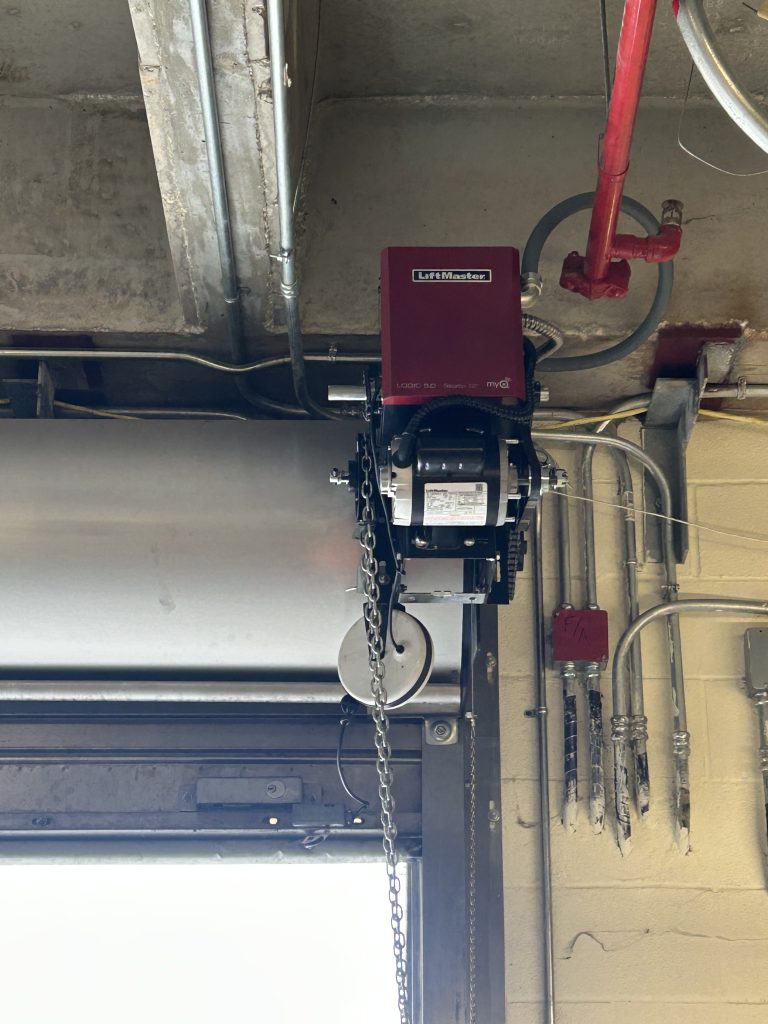
Direct Answer: If your commercial rolling door motor hums or clicks without lifting, the system is likely stalled by an active hoist interlock switch, a seized solenoid brake, lost three-phase power, or broken internal counter-balance barrel springs. When the operator cannot overcome the curtain’s dead weight, it protects itself from burning out by stalling.
SAFETY WARNING: Commercial rolling steel doors weigh hundreds to thousands of pounds and utilize high-tension torsion springs enclosed inside the overhead barrel pipe. Never attempt to adjust curtain tension, chain drives, internal springs, or structural mounting brackets yourself. Severe crush injuries and fatalities can occur. Always rely on a certified commercial door technician.
Understanding Commercial Hoist & Jackshaft Operator Failures
Industrial coiling doors rely on industrial operators (such as the LiftMaster Logic 5.0 series shown above) directly coupled to the rolling curtain’s drive shaft via sprockets and roller chains. Unlike residential trolley openers that pull a lightweight panel, commercial jackshaft operators manage enormous torque loads. When an operator hums without moving the curtain, the motor is receiving voltage but mechanical resistance or electrical phase imbalance is preventing rotation.
Common Causes vs. Solutions
| Symptom / Cause | Underlying Mechanism | Professional Resolution |
|---|---|---|
| Engaged Chain Hoist Interlock | The auxiliary manual emergency chain hoist has an electrical interlock microswitch cut out to prevent simultaneous motor and manual operation. | Inspect and reseat the manual disconnect cable/chain interlock to re-engage electrical power safely. |
| Seized Mechanical Solenoid Brake | Heavy-duty operators use friction disc brakes to hold doors open; if the solenoid fails to release upon signal, the motor cannot turn. | Test brake solenoid voltage and replace worn brake pads or mechanical assemblies. |
| Broken Internal Barrel Springs | Counterbalance springs enclosed inside the curtain barrel snap from metal fatigue, leaving the door as dead counterweight. | Requires professional overhead barrel drop and spring replacement under controlled tensioning equipment. |
| Single-Phasing / Capacitor Failure | Loss of one electrical leg in 3-phase systems or a blown start capacitor in 1-phase units leaves motor with insufficient starting torque. | Licensed electrical diagnosis of supply voltage, contactor points, and motor windings. |
Safe Troubleshooting Steps for Facility Managers
Before calling an industrial door contractor, facility maintenance personnel can perform these safe preliminary verifications without touching high-tension components:
- Verify the Emergency Pull Chain: Ensure that the emergency chain hoist disconnect cable is not partially pulled or wedged, which keeps the electrical safety cutoff switch open.
- Check the Operator Diagnostics: Remove the control panel cover (or observe external diagnostic LEDs on the Logic board) to read the yellow or red blink error codes indicating brake or photo-eye interlocks.
- Inspect the Side Guides: Visually inspect the steel vertical guides for forklift impact damage, pinched slats, or foreign obstructions that physically jam the curtain.
- Listen to the Operator Sound: A loud magnetic hum indicates motor electrical energization without rotation (stalled condition), while total silence indicates an open thermal overload or safety interlock circuit.
When to Call an Industrial Door Specialist
If your manual chain hoist feels impossible to pull by hand, do not attempt to force it. An immobilized rolling steel door usually signals that the internal counterbalance mechanism has failed, transferring thousands of pounds directly onto the drive gears. Contact a commercial door specialist immediately to isolate the equipment and perform structural repairs.