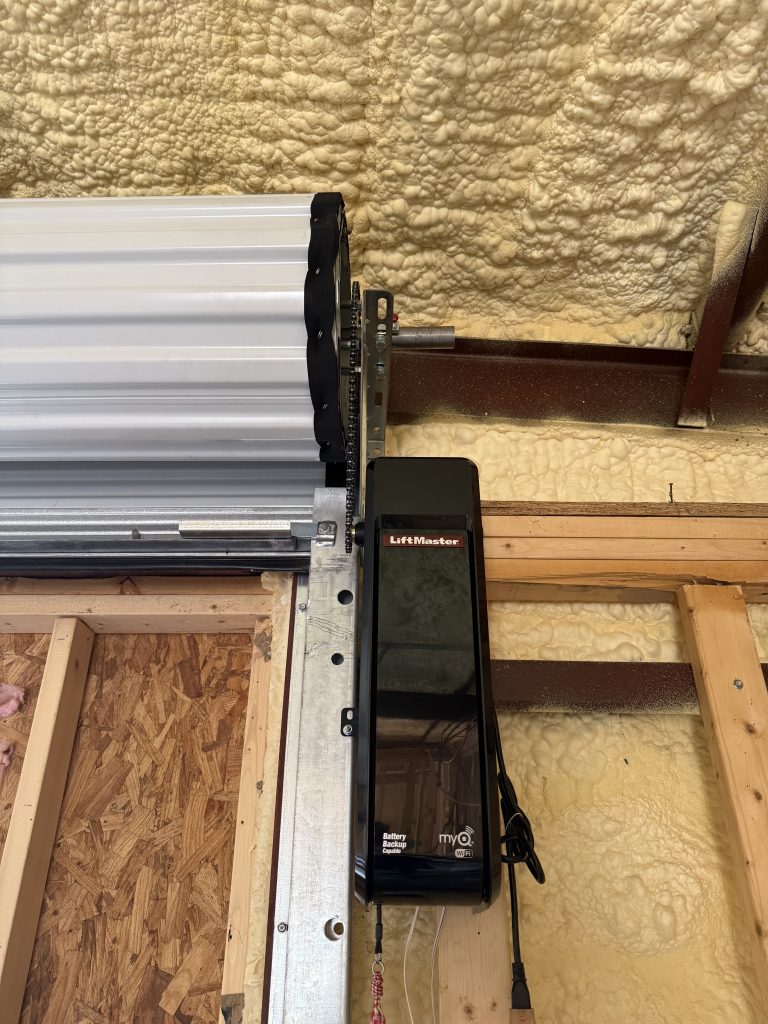
Yes, you can install a residential wall-mount opener on a corrugated roll-up sheet door by utilizing an auxiliary chain-and-sprocket conversion kit. The setup requires a properly counterbalanced barrel spring, structural header blocking, and precise drive chain alignment to prevent premature motor wear, chain jumping, and curtain binding.
SAFETY WARNING: Corrugated roll-up sheet doors contain extreme torsion force inside the enclosed drum barrel. Never attempt to tension, wind, or release the internal spring mechanism yourself. Improper handling of high-tension barrels, heavy curtain assemblies, or drive sprockets can cause severe trauma or life-threatening injuries. All counterbalance adjustments and structural bracket mounting must be handled by a certified overhead door technician.
How a Jackshaft Chain-Drive Retrofit Works
Unlike standard sectional overhead doors that feature an external torsion bar running through center bearings, roll-up sheet doors wind around an internal axle drum assembly. Because standard wall-mount operators (such as the LiftMaster 8500 or 98022 series) are designed to slide directly over a 1-inch solid or hollow torsion shaft, pairing them with a corrugated sheet door requires a secondary chain-and-sprocket drive system.
A mounting bracket secures the side-mount motor adjacent to the curtain coil. A drive sprocket is installed on the motor shaft, which links via heavy-duty roller chain (typically #41 or #48 chain) to a matching drive gear bolted to the roll-up door’s drum wheel. This gear-reduction setup transfers rotational torque directly to the door roll, lifting the curtain effortlessly.
Crucial Requirements for a Successful Installation
1. Neutral Counterbalance Balance
Residential wall-mount motors are rated for push-pull balance, not dead-weight lifting. The internal barrel spring inside the roll-up door must be properly tensioned so the door lifts smoothly by hand with minimal effort. If the door feels heavy, the motor’s internal force sensors will trip, causing phantom reversals or burned-out logic boards.
2. Rigid Structural Backing
As seen in pole barns and insulated metal buildings, rotational torque will twist the motor if it is anchored only into sheet metal. Solid structural timber framing or steel angle iron must be bolted directly into the building’s support posts to absorb continuous dynamic torque.
3. Correct Chain Tension and Sprocket Alignment
The drive chain connecting the motor to the drum gear must have between 1/4-inch and 1/2-inch of total deflection. Excessive slack allows the chain to whip, climb the sprocket teeth, or derail, while an over-tightened chain exerts lateral shear stress on the motor’s output shaft bearings.
Causes vs. Solutions for Roll-Up Jackshaft Systems
| Issue Observed | Underlying Cause | Professional Solution |
|---|---|---|
| Motor hums, trips safety reverse, or stalls midway | Weak internal barrel spring or curtain binding in track guides | Have a technician adjust internal spring ratchets and apply silicone lubricant to guides. |
| Loud metallic popping or chain jumping sprockets | Misaligned motor mounting bracket or excessive chain slack | Laser-align motor and drum sprockets; adjust slotted mounting bracket for correct tension. |
| Operator vibrates and flexes off the wall framing | Insufficient structural blocking on post-frame wall | Reinforce mounting surface with structural 2×6 timber or heavy-gauge steel unistrut. |
Troubleshooting a Retrofitted Roll-Up Motor
- Verify Manual Operation: Disengage the emergency disconnect cable and test door balance manually. If the door drops quickly or refuses to stay open at waist height, call a professional to balance the internal drum spring.
- Check Sprocket Parallelism: Ensure the operator drive sprocket and drum sprocket are perfectly square. Even a 3-degree deviation causes accelerated chain wear and sprocket tooth chipping.
- Inspect Travel Limits: Electronic travel limits must be set so the curtain bottom bar touches the floor without forcing downward pressure that buckles the bottom slat.
- Examine Power Head Stability: Check all lag screws securing the opener bracket to the wood frame. Any play will degrade the internal drive gears over time.