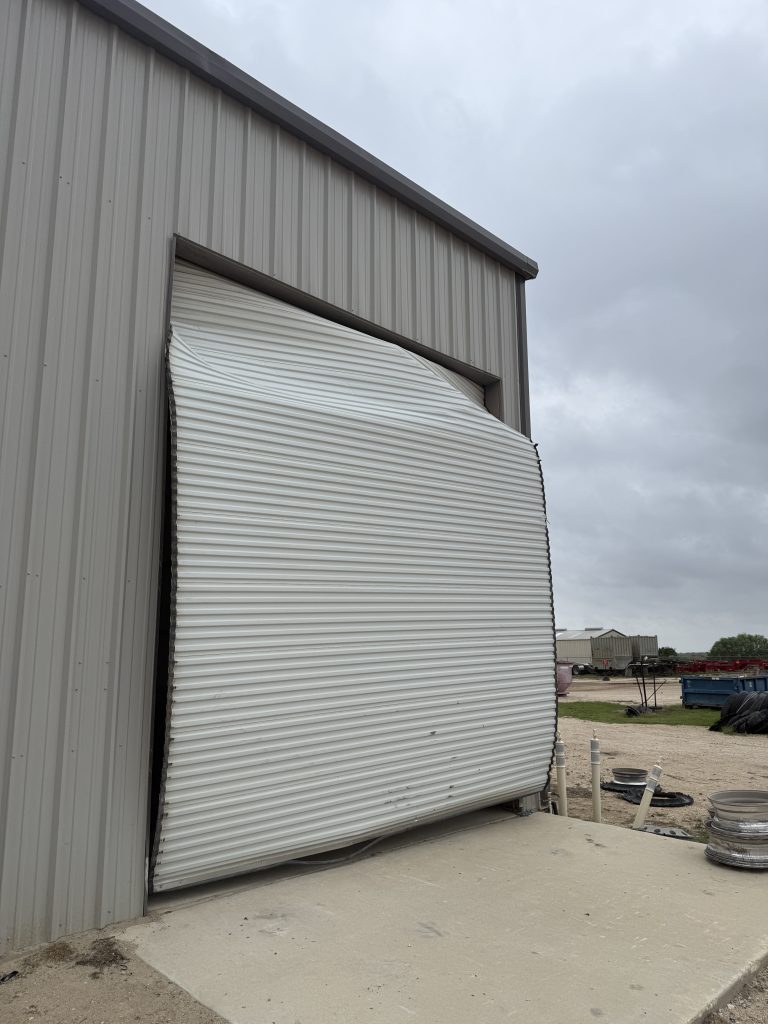
High winds blow a commercial roll-up door curtain out of its tracks when extreme negative or positive wind pressures exceed the guide channel depth or shear strength of the windlocks. Unreinforced non-wind-rated doors bow significantly under storm gusts, pulling the corrugated steel edges completely out of the vertical guides.
SAFETY WARNING: Never attempt to force, push, or operate a roll-up sheet door that has blown out of its guides. The curtain is under severe structural tension and could collapse instantly, while the internal barrel spring remains charged with lethal torque. Secure the perimeter and contact a licensed commercial overhead door technician immediately.
Why Severe Wind Events Blow Roll-Up Doors Out of Their Guides
Commercial roll-up sheet doors span large openings on metal industrial buildings, making them the largest and most vulnerable pressure surfaces during severe weather. When gale-force winds hit a warehouse, two primary aerodynamic forces act upon the door assembly:
1. Positive Pressure vs. Negative Suction
When wind strikes the closed door head-on, positive pressure pushes inward, bowing the curtain toward the building interior. Conversely, as wind whips across the roof or around the corners of the structure, it creates severe aerodynamic drag and negative pressure (suction) on leeward or side walls. This suction violently pulls the corrugated sheet outward. Without sufficient guide engagement, the continuous steel curtain flexes beyond its elastic limit and pops free of the side channels.
2. Lack of Heavy-Duty Windlocks
Standard roll-up doors rely solely on standard guide depth to hold the edges of the curtain in place. Wind-rated commercial doors, by contrast, incorporate heavy steel windlocks riveted directly to the curtain edges at regular intervals. These windlocks engage a matching structural retention lip inside heavy-gauge guide channels. If an opening is fitted with a standard-duty door lacking windlocks, even moderate gusts (45–60 mph) can cause the curtain to buckle and pull out.
3. Building Jamb and Guide Deflection
On pre-engineered steel buildings, the jambs themselves can deflect outward under storm loads. If the structural framing flexes outward while the curtain deflects inward or outward, the total track-to-curtain overlap drops to zero, releasing the curtain entirely.
Causes vs. Solutions for Wind-Damaged Roll-Up Doors
| Root Cause | Structural Impact | Commercial Solution |
|---|---|---|
| Non-Wind-Rated Door Installed | Curtain flexes under suction and unseats from shallow guides. | Replace with an engineered, wind-load certified commercial door with continuous windlocks. |
| Sheared Windlock Rivets | Curtain tears free from end-locks under extreme cyclic gusts. | Install heavy-gauge steel slat coiling doors designed for higher design pressure (DP) ratings. |
| Guide Mounting Failure | Fasteners pull out of steel or timber jambs due to lateral wind loads. | Reinforce building structural jambs with through-bolts and heavy structural angle guides. |
| Bottom Bar Distortion | Bottom angle bows, releasing the lower corners from the guides first. | Upgrade to heavy double-angle bottom bars reinforced with structural slide locks. |
Post-Storm Site Inspection Checklist
When assessing a commercial door that has suffered wind displacement, warehouse supervisors should take the following non-operational safety precautions:
- Isolate the Power and Controls: Immediately shut off the breaker or disconnect the commercial operator to prevent accidental activation via remote or wall station.
- Establish a Safe Clearance Zone: Cordon off the interior and exterior areas around the door opening; a hanging, creased curtain can drop unpredictably.
- Inspect Structural Jambs for Twisting: Check whether the steel building uprights or girts have bent, which indicates building-wide structural stress.
- Do Not Cut or Pry the Sheet: The top barrel contains a high-torque torsion spring counterbalancing hundreds of pounds of steel. Cutting the sheet releases this energy uncontrollably.
Preventing Future Wind Failures
Recovering from a blown-out door requires more than bending the metal back into place. Once corrugated continuous sheet curtains crease, their structural integrity is permanently compromised. Upgrading to a door system tested to local building code Design Pressure (DP) specifications ensures your warehouse envelope stays intact during high-wind events.