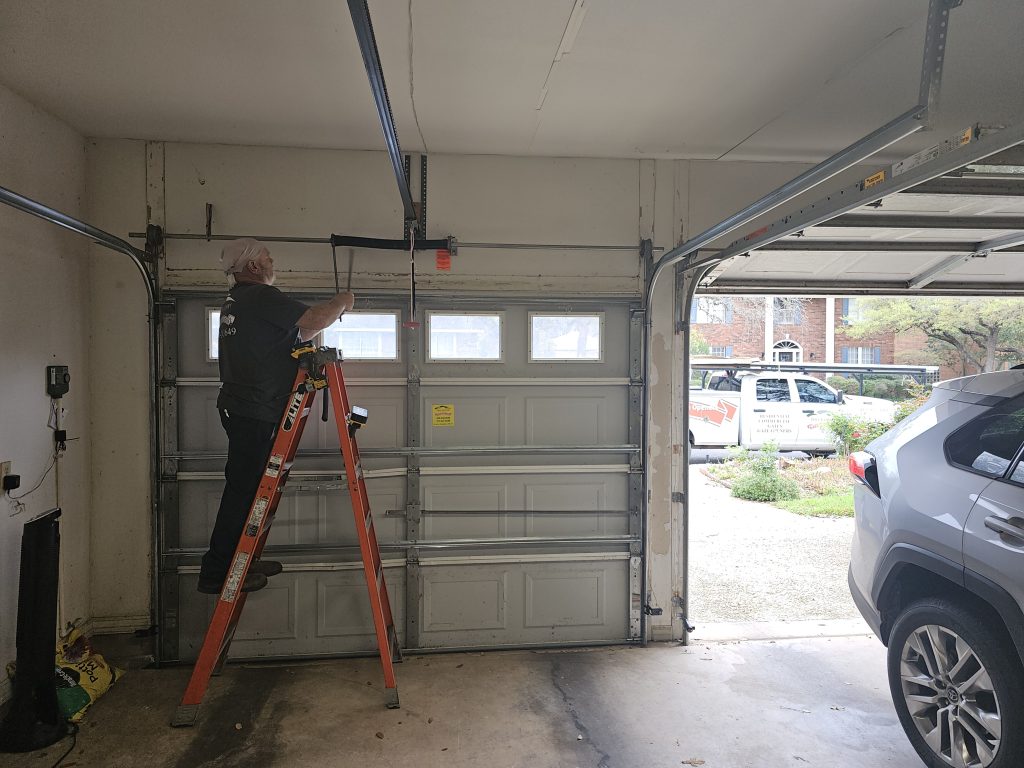
Direct Answer: A garage door torsion spring counterbalances the door’s heavy weight, enabling seamless manual and motorized operation. When springs lose tension or snap after reaching their cycle limit (typically 10,000 cycles), the door will fail to lift. Due to high mechanical tension, spring service must strictly be performed by a professional technician.
⚠️ CRITICAL SAFETY WARNING: Garage door torsion springs, winding cones, and lift cables are under extreme kinetic tension capable of causing catastrophic injury, bone fractures, or death. Never attempt to adjust, tighten, loosen, or replace torsion springs yourself. Always contact a certified, licensed garage door professional equipped with proper winding bars and safety gear.
Understanding Garage Door Torsion Springs
Torsion springs are mounted horizontally on a steel shaft directly above your garage door opening. Rather than stretching like extension springs, torsion springs rotate and store torque as the door closes, releasing that energy to help lift the heavy door panels during opening. Over years of daily operation, metal fatigue inevitably causes springs to lose calibration or snap entirely.
Common Symptoms of a Failing or Broken Spring
- A Loud Bang in the Garage: When a torsion spring breaks, it releases stored energy instantly, producing a sound similar to a gunshot.
- Opener Motor Strains or Halts: If your garage door opener lifts the door 2 to 6 inches and immediately stalls, the spring is likely broken, forcing the motor to bear the full deadweight.
- Visible Separation in the Coil: A broken torsion spring displays a visible 2- to 3-inch gap where the steel coil sheared apart.
- Crooked Door or Slack Cables: If tension is lost, the lift cables may jump off the drums, causing the door to hang unevenly.
- Heavy Manual Lifting: In emergency release mode, a balanced door should be easy to lift with one hand. If it feels extremely heavy, the springs are exhausted.
Torsion Spring Issues: Causes vs. Solutions
| Issue / Cause | Operational Symptom | Professional Solution |
|---|---|---|
| Metal Fatigue (Cycle Life Reached) | Spring snaps completely; visible gap in coils. | Complete dual spring replacement with matched high-cycle oil-tempered springs. |
| Loss of Spring Tension | Door feels heavy, opener struggles or reverses. | Professional tension recalibration using calibrated winding bars. |
| Rust and Corrosion | Squeaking, friction, premature coil stress. | Professional lubrication, rust removal, or full spring assembly upgrade. |
| Cable Drum Slippage | Door lifts crooked; cables unravel from drum. | Professional drum realignment, cable reset, and spring re-tensioning. |
Why Professional Replacement is Mandatory
Calibrating and replacing torsion springs requires specialized winding cones, heavy-duty winding bars, and precise mathematical calculations based on the door’s total weight, track radius, and wire gauge. Using improper tools like screwdrivers or pliers can cause the winding cone to violently spin out of control. Certified technicians possess the specialized equipment and training to safely neutralize tension and ensure balanced, safe door operation.