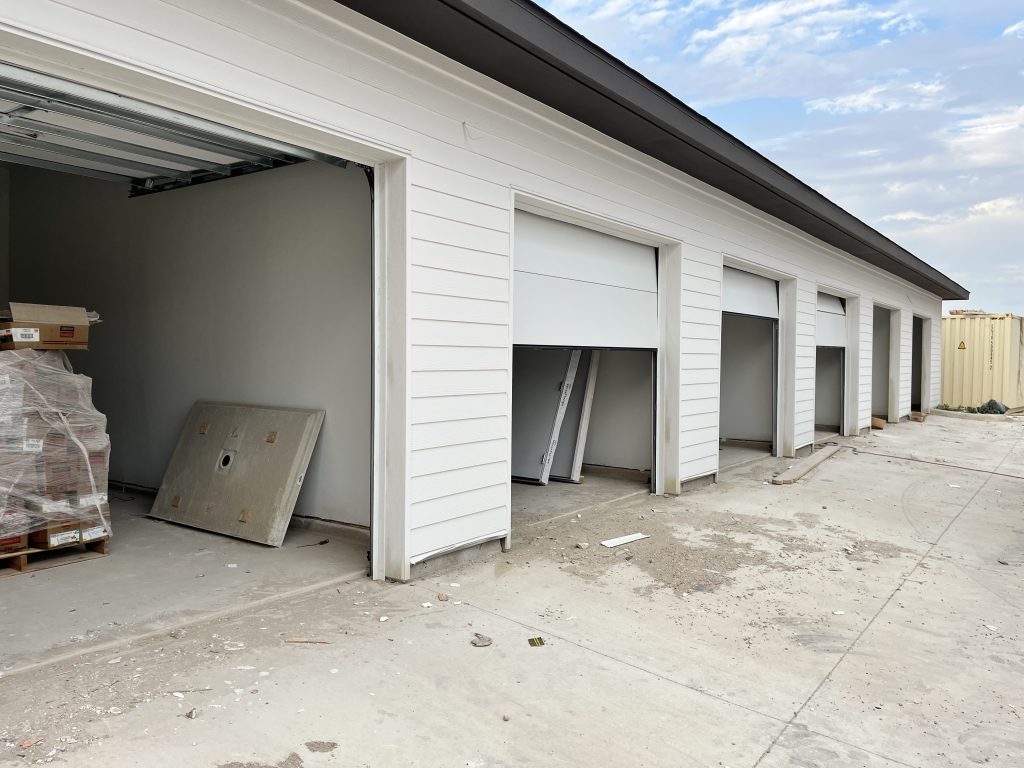
A garage door stuck crooked halfway down during new construction typically occurs due to uneven track spacing, out-of-square framing, prematurely set spring counterbalance tension, or a thrown lift cable. When panels bind against improperly spaced vertical tracks before final leveling and counterbalance balancing, the assembly wedges securely in place.
SAFETY WARNING: Overhead garage door assemblies, counterbalance springs, and steel lift cables operate under extreme mechanical tension. Never attempt to force free a bound panel, adjust spring drums, or loosen hardware while sections are elevated. Uncontrolled release can cause catastrophic panel collapse, severed fingers, or life-threatening blunt trauma. All adjustments must be performed by a trained overhead door professional.
Understanding New Construction Garage Door Binding
During the framing and rough-in phase of residential or commercial multi-bay buildings, sectional garage doors are frequently installed before the building settling, exterior trim, or interior drywall is finalized. When a door hangs askew mid-opening, it indicates that the geometric alignment between the vertical tracks and the door curtain has failed. Overhead sectional doors require tolerances as tight as 1/16th of an inch across the horizontal and diagonal planes to glide smoothly along the radius curves.
1. Out-of-Plumb Jambs and Header Deflection
In newly framed buildings, green framing lumber, settling concrete slabs, or slight framing errors can force vertical jambs out of plumb. If the jambs taper inwards toward the top, the vertical track spacing narrows. As the sectional panels elevate, the roller stems bottom out inside the hinge carriers, pinching the door between the tracks and causing it to seize diagonally.
2. Uneven Cable Drum Spooling and Torsion Imbalance
A sectional garage door relies on twin aircraft-grade lift cables attached to the bottom brackets and wound around grooved aluminum drums on a torsion shaft. If one cable jumps a drum groove, unspools unevenly, or experiences tension failure while the springs are partially wound, one side drops while the other holds. This racks the door curtain across the opening, locking the roller wheels against the track ribs.
Causes vs. Solutions for Stuck Construction Garage Doors
| Probable Cause | Mechanical Symptom | Professional Solution |
|---|---|---|
| Narrow or Tapering Track Spacing | Rollers bind hard against track walls as the door ascends. | Measure track width bottom-to-top; shim track brackets to maintain uniform distance. |
| Thrown or Slipped Lift Cable | One side hangs significantly lower than the other; cable slack visible. | Lock the torsion assembly, secure sections on locking clamps, and reset cables on drums under zero tension. |
| Unlevel Slab or Foundation Pad | Bottom section sits racked, misaligning all upper sections sequentially. | Scribe bottom panel or adjust lower track positioning to square the initial section. |
| Improper Staging During Installation | Panels installed out of sequence or without proper intermediate support. | Re-stack sections sequentially from bottom to top using mechanical door panel supports. |
Visual Troubleshooting Steps for Builders and Supervisors
If a garage door jams mid-travel during rough construction, perform these visual inspections safely from a distance without touching tensioned hardware:
- Check the Track Spacing: Measure the width between the left and right vertical tracks at the floor, header, and highest point to confirm they are parallel.
- Inspect Cable Drums: Look up at the torsion shaft above the opening to verify both cables are seated correctly in their respective drum grooves without bird-nesting.
- Verify Roller Placement: Check if roller shafts have adequate float inside the hinge sleeves or if they are pressed firmly against the bracket bodies.
- Examine Header Clearance: Confirm that temporary construction bracing or debris is not obstructing the horizontal track hanger run.
- Call a Certified Technician: Cease operation immediately and tag out the bay until an experienced technician releases the spring tension and squares the opening.