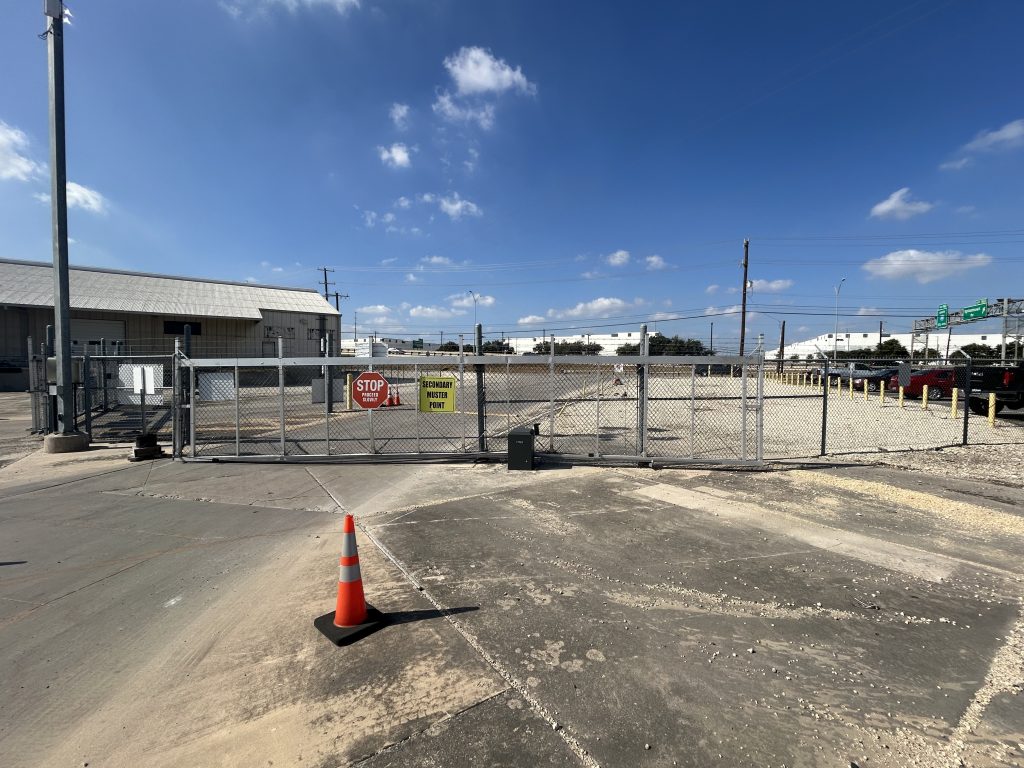
Direct Answer: If your commercial cantilever slide gate is stuck or failing to open, the issue is typically caused by obstructed photo-eye sensors, misaligned cantilever rollers, debris in the guide track, broken drive chains, or an internal gate operator failure. Immediate visual inspection and professional servicing restore security and perimeter safety.
SAFETY WARNING: Commercial automated sliding gates weigh hundreds to thousands of pounds and operate under high mechanical torque and electrical voltage. Never attempt to manually force, adjust tension chains, or alter high-voltage operator circuitry without certified training. Improper handling can cause catastrophic pinch injuries, entrapment, or fatal crushing. Always contact a licensed commercial gate technician for mechanical repairs.
Understanding Commercial Cantilever Slide Gate Systems
Cantilever slide gates are essential security assets for industrial facilities, distribution centers, and commercial yards. Unlike standard rolling gates that glide on ground tracks, cantilever gates are suspended above the driveway, relying on heavy-duty counterbalance posts, internal roller assemblies, and motorized drive units to slide horizontally.
Primary Causes of Cantilever Gate Malfunctions
When an automated sliding gate fails to respond to access control credentials or stalls midway, several factors may be responsible:
- Entrapment Protection & Sensor Tripping: Under UL 325 safety standards, commercial gate operators use monitored safety photo-eyes and contact edges. Dirt, cobwebs, misalignment, or direct sunlight flare can trip these safety devices, causing the gate to lock open or refuse to close.
- Roller Assembly and Guide Track Wear: Over time, sealed bearing cantilever rollers endure severe weather and heavy cycling. Worn, seized, or misaligned rollers create immense drag, tripping the operator’s mechanical overload sensors.
- Operator Drive Chain & Gearbox Issues: Slack, rusted, or snapped drive chains, worn sprockets, or hydraulic fluid leaks within the motor enclosure will prevent the operator from transmitting torque to the gate frame.
- Power Supply and Access Control Faults: Blown fuses, tripped industrial breakers, dead backup batteries, or faulty keypad/loop detectors will completely disable the system.
Troubleshooting and Inspection Guide
Facility managers can perform the following preliminary checks prior to scheduling certified repair:
- Check the Safety Sensors: Inspect photo-eye lenses on both sides of the gate opening for dirt, ice, or physical misalignment. Ensure the diagnostic LED indicator shows active alignment.
- Verify Power and Breakers: Ensure the main electrical disconnect switch near the gate operator has not tripped.
- Inspect Drive Chain and Hardware: Visually examine the drive chain along the gate frame for excessive sag, disconnected links, or foreign debris lodged in the idler pulleys.
- Examine the Frame for Sagging: Sight down the top and bottom rails to ensure the cantilever frame has not bowed or drifted out of its counterbalance guides.
Causes vs. Solutions
| Symptom / Cause | Potential Source | Recommended Solution |
|---|---|---|
| Gate clicks but does not move | Seized cantilever roller or chain off sprocket | Professional roller replacement and chain re-tensioning |
| Gate starts moving, then reverses immediately | Tripped photo-eye or excessive mechanical resistance | Clean sensor lenses; have a technician tune motor torque limits |
| Gate does not reach full open/close position | Misadjusted limit switches or worn stop brackets | Professional recalibration of internal magnetic/cam limit switches |
| Total system unresponsiveness | Tripped surge protector, blown fuse, or control board failure | Certified electrical testing and master board diagnostics |
Why Professional Service Is Critical
Due to the immense weight and momentum of industrial cantilever gates, structural realignment and motor repairs must adhere strictly to ASTM F2200 and UL 325 compliance standards. Certified commercial technicians possess the crane support equipment, diagnostic analyzers, and load-rated hardware required to return your perimeter security to full operational safety.