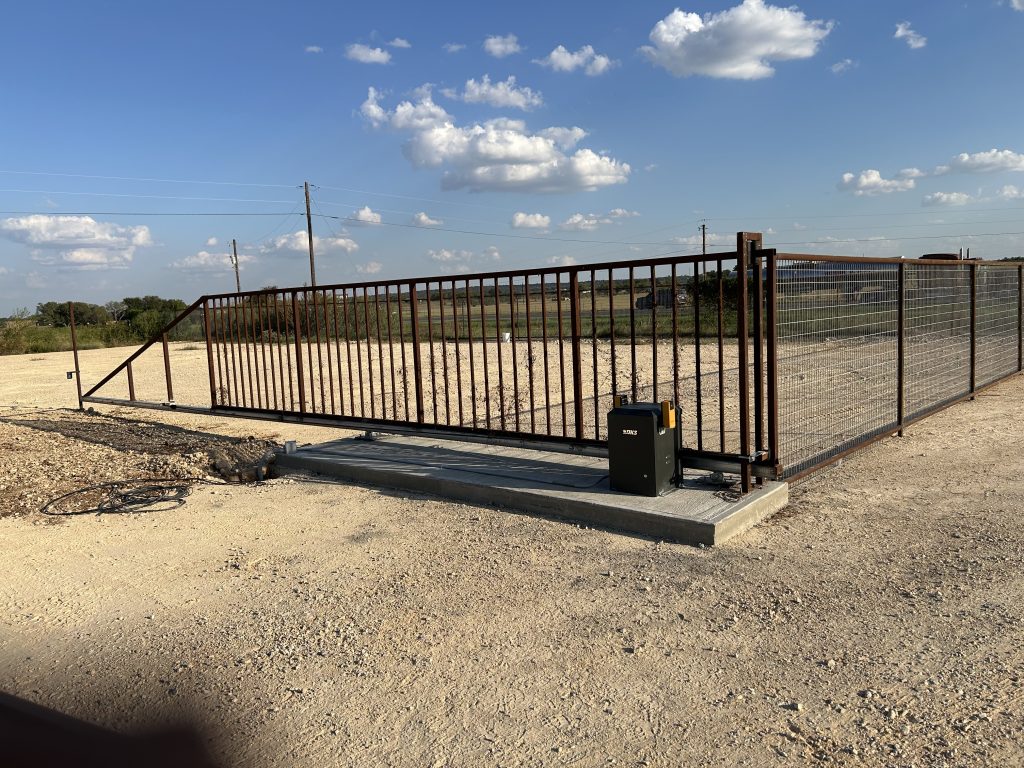
Direct Answer: An automatic sliding gate fails to operate smoothly when affected by physical track obstructions, misaligned safety sensors, improper drive chain tension, or internal operator motor wear. Heavy cantilever steel gates demand exact balance and calibrated limit switches; any structural sagging or electrical fault will trigger safety reversals or motor stalls.
SAFETY WARNING: Heavy automated security gates, industrial slide operators (such as DoorKing / DKS systems), and high-voltage electrical connections present severe pinch, crush, and entrapment hazards. Never attempt DIY adjustments on drive chains, counterbalance hardware, internal motor gears, or electrical panels. Repairs must be handled exclusively by a certified, professional gate technician to prevent catastrophic injury or death.
Understanding Heavy-Duty Slide Gate Mechanisms
Automated slide and cantilever gates are engineered to secure commercial properties, ranches, and industrial perimeters. Unlike standard swing gates, cantilever slide gates utilize an extended counterbalanced tail section suspended above the driveway, supported by heavy-duty internal roller assemblies mounted securely to a reinforced concrete foundation pad. The system relies on an electric operator—often driving a continuous #40 or #50 roller chain—to smoothly translate rotational motor torque into lateral movement.
Causes vs. Solutions for Slide Gate Failures
| Symptom / Cause | Underlying Issue | Professional Solution |
|---|---|---|
| Gate stops and reverses midway | Blocked safety photo eyes, dirty reflectors, or edge sensor trip | Clean optical lenses, realign photo eyes, and inspect safety edge wiring. |
| Operator hums but gate doesn’t slide | Seized guide rollers, sheared drive pin, or failed motor capacitor | Inspect gear drive, replace defective capacitors, and service sealed roller bearings. |
| Jerky movement or sagging gate frame | Sagging cantilever tail, loose chain tension, or foundation settling | Re-level cantilever track brackets, torque mounting hardware, and adjust chain tension. |
| No response from remote or keypad | Tripped breaker, blown control board fuse, or dead receiver battery | Diagnose low-voltage control board, reset safety loop detectors, and restore power. |
Safe Troubleshooting Checklist for Site Managers
Before calling for field service, site operators and property owners can perform these non-invasive safety checks:
- Inspect the Optical Safety Eyes: Check that the infrared sender and reflector on the gate posts are clean of dirt, cobwebs, and moisture, and verify that alignment LEDs are solid.
- Verify Power and Breakers: Confirm that the dedicated circuit breaker supplying the operator pad has not tripped due to an electrical surge.
- Check the Travel Path: Ensure the gravel, concrete apron, and fence line are clear of brush, rocks, or debris that could physically obstruct the frame.
- Listen to the Operator Housing: Note whether the motor clicks, hums, or remains completely silent when receiving a command signal.
Why Professional Gate Service is Essential
Cantilever and slide gates weigh hundreds to thousands of pounds. A gate that derails or experiences a mechanical failure can cause severe property damage or life-threatening crush injuries. Licensed gate technicians carry the specialized diagnostic tools, force-testing gauges, and manufacturer replacement parts required to maintain UL 325 safety standard compliance and keep your automated security perimeter functioning reliably.