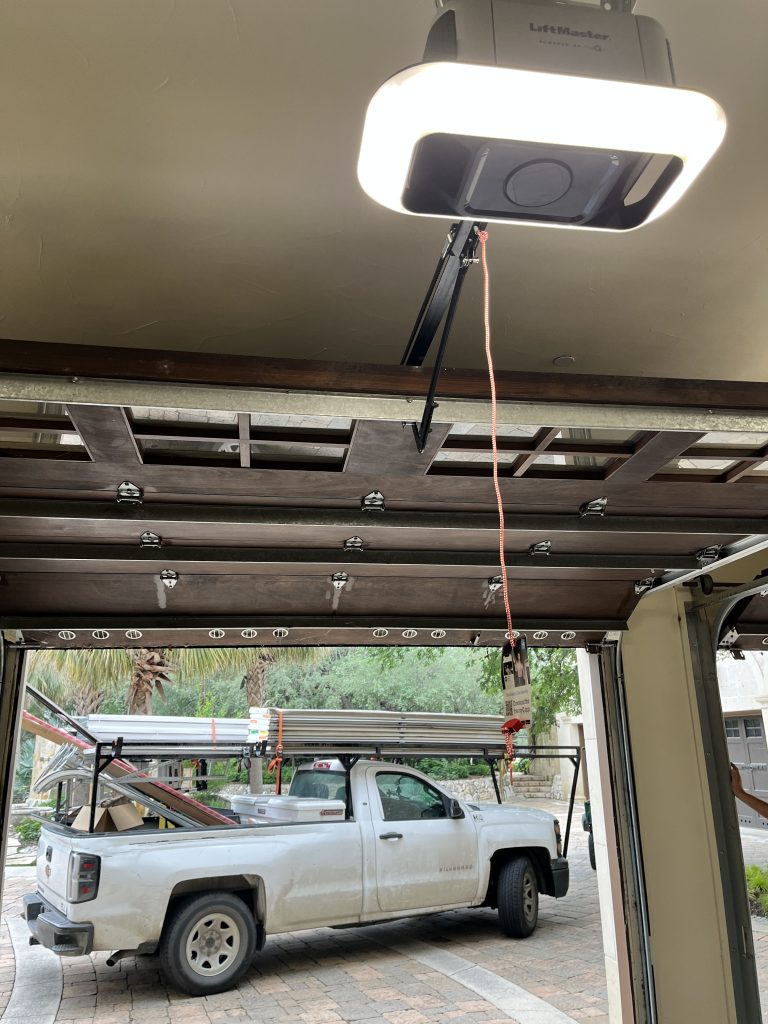
Direct Answer: The top panel of a wood garage door bends when the opener pulls it because heavy custom wood sections generate immense static inertia. Without a full-span steel operator reinforcement strut, the trolley arm exerts concentrated pulling force directly onto the top rail, causing panel deflection, structural cracking, and eventual hardware failure.
Safety Warning: Custom wood garage doors can weigh between 300 and 800 pounds, relying on extreme spring tension for counterbalance. Never attempt to loosen hinge bolts, adjust spring tension, or reposition the opener towing arm yourself. An unbalanced heavy wood panel can collapse rapidly or snap tension cables, causing severe injury or structural damage. Always contact a certified garage door technician.
The Mechanics Behind Top Panel Deflection in Wood Doors
Custom wood and carriage-house garage doors are admired for their architectural elegance, but they present unique engineering challenges. Unlike lightweight stamped steel doors, solid timber or wood-composite doors possess significant mass. When an automated trolley opener starts its cycle, it does not lift the door straight up—it pushes and pulls horizontally along a central rail before the door rounds the track radius.
If the opener’s drawbar (the J-arm) is fastened directly to the center stile of the top section without a continuous, structural horizontal strut, all starting torque concentrates on a localized area just a few inches wide. Over time, this concentrated strain pulls the top panel inward, causing visible flexing, joint separation, and cosmetic or structural damage.
Key Causes vs. Professional Solutions
Addressing top section bending requires identifying whether the issue stems from missing structural components, bad opener geometry, or an uncalibrated counterbalance system.
| Underlying Cause | Visible Symptom | Professional Solution |
|---|---|---|
| Missing Reinforcement Strut | Top rail bows inward as the motor starts lifting; center hinge pulls away. | Install a full-span, heavy-gauge galvanized steel reinforcement strut (2-1/4″ or 3″) across the top section. |
| Weak or Fatigued Torsion Springs | Opener motor strains, groans, or jerks the top panel upward aggressively. | Perform spring tension testing and install high-cycle commercial-grade torsion springs matched to the door’s exact deadweight. |
| Incorrect J-Arm Geometry | Opener arm pushes downward rather than rearward, jamming the top rollers into the header. | Reconfigure the opener bracket mounting height and adjust the straight-to-curved arm link angle. |
| Binding Track Radii or Rollers | Door shudders or catches when transitioning from vertical to horizontal track. | Inspect and realign vertical-to-horizontal track transitions and replace worn steel rollers with heavy-duty sealed ball-bearing rollers. |
Troubleshooting and Inspection Guide for Homeowners
Homeowners can safely evaluate the condition of their wood garage door system through visual observation without manipulating hazardous high-tension components:
- Watch the Initial Lift: Stand safely off to the side while operating the door from a wall button. Watch where the metal arm attaches to the top wood section. If the wood pulls inward more than 1/4 inch before the rollers begin rolling back, support reinforcement is critically needed.
- Inspect for Cracking or Glue Separation: Check the interior face of the top wooden panel around the center bracket. Look for hairline cracks along wood grains, popping screws, or split rail joints.
- Check for Strut Presence: Examine the top edge of the top section. A properly equipped custom door will feature a horizontal U-shaped steel bar spanning the entire width of the panel. If your door lacks this bar, the opener is pulling directly against timber.
- Listen for Opener Laboring: High-end modern openers with DC motors automatically adjust speed, but a distinct low-frequency grinding or motor gear whine indicates the opener is fighting excessive deadweight rather than a balanced load.
Protecting Your Investment with Professional Balancing
A garage door opener is an automated assistant, not a crane. Even the most powerful 1-1/4 HP or high-torque DC motor should never lift deadweight. A properly counterbalanced wood door should hover effortlessly at mid-travel when lifted manually. If your top panel is flexing, contact a licensed garage door technician immediately to secure the panel with structural struts and rebalance your spring assembly before permanent wood framing failure occurs.