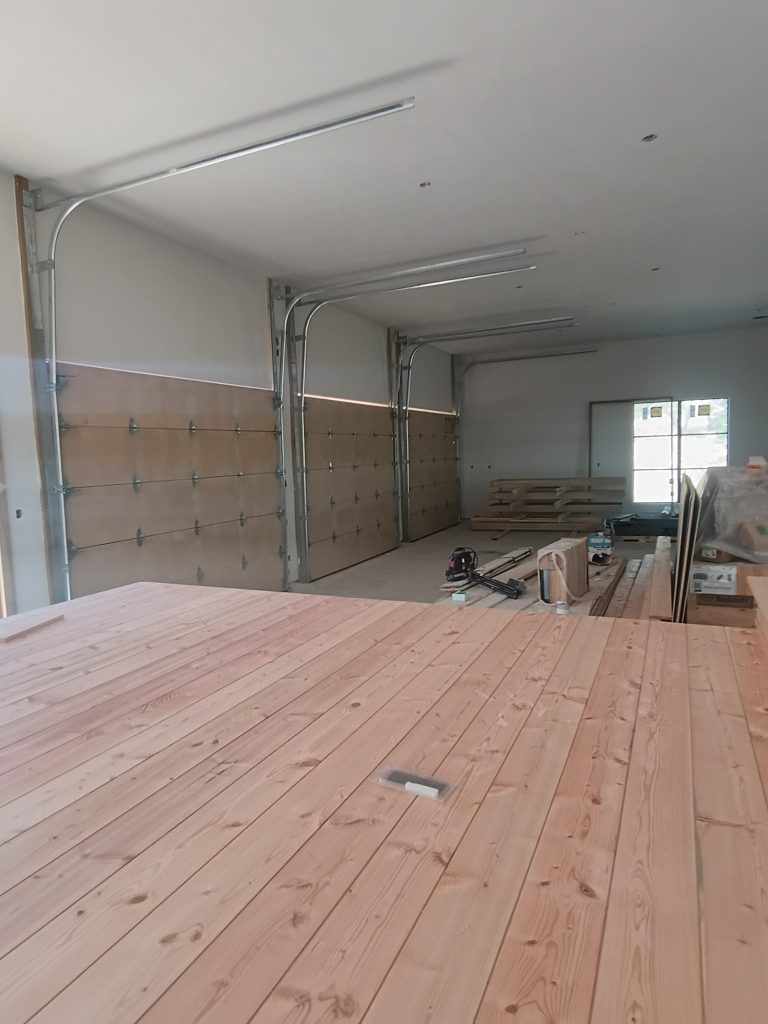
A high-lift garage door requires tapered cable drums because the door moves straight upward before transitioning into the horizontal tracks. Unlike standard doors that immediately roll horizontal, a high-lift door keeps its full weight hanging longer. Tapered drums gradually change the cable’s moment arm, matching the spring’s unwinding torque to keep constant cable tension.
SAFETY WARNING: High-lift garage door assemblies operate under extreme torsion spring tension. Tapered drums, high-lift cables, and torsion shafts store massive amounts of kinetic energy capable of causing severe injury or death. Never attempt to adjust, loosen, or service counterbalance hardware without professional training and specialized tools.
Understanding the Physics of High-Lift Track Systems
In standard residential garage door configurations, the door panels begin turning horizontal almost immediately after clearing the opening header. As panels transition onto the horizontal tracks, their dead weight transfers from the vertical lift cables to the horizontal track framing. Consequently, standard systems use flat, cylindrical cable drums because the torque needed from the torsion springs decreases at a predictable, linear rate.
High-lift systems extend the vertical track significantly higher—often reaching near high ceilings in custom builds, pole barns, or garages designed for automotive lifts. Because the door travel remains entirely vertical for several additional feet, the full gravitational load of the heavy door panels remains on the cables far longer during the cycle.
How Tapered Drums Balance Changing Cable Tension
If you installed standard flat drums on a high-lift assembly, the torsion springs would lose torque while the entire door weight was still hanging vertically. The door would feel excessively heavy halfway up, causing it to stall, or the cables would develop dangerous slack as spring tension diminishes unevenly.
High-lift drums solve this problem with a dual-geometry design: a tapered, spiral cone section paired with a flat cylindrical section:
- The Tapered Section: When the door is closed, the lift cable rests on the widest diameter of the drum’s cone. As the door begins to rise vertically, the cable wraps down the tapered spiral toward a smaller diameter. This shifting radius mechanically compensates for the spring unwinding, maintaining uniform lift assistance.
- The Flat Section: Once the door sections finally hit the horizontal bend and their weight transfers to the tracks, the cable transitions onto the flat section of the drum for the remainder of the travel.
Causes vs. Solutions: High-Lift Counterbalance Issues
| Symptom | Mechanical Root Cause | Professional Solution |
|---|---|---|
| Cable jumps drum grooves during initial lift | Incorrect drum taper ratio or mismatched torsion spring wire gauge. | Calculate exact high-lift inches and door weight to install paired high-lift drums. |
| Door slams down when closing from mid-travel | Standard flat drums used on a high-lift track, starving the door of spring assist. | Retrofit high-lift engineered tapered drums and recalibrate spring turns. |
| Cable goes slack when door reaches full open | Improper cable length or incorrect drum orientation relative to the shaft. | Reset shaft pre-load, verify cable tension, and level door panels under tension. |
| Excessive opener strain or motor gear stripping | Trolley opener pulling downward against vertical tracks instead of a jackshaft unit. | Replace ceiling drawbar operator with a direct-drive wall-mount jackshaft opener. |
Troubleshooting and Inspecting High-Lift Garage Doors
Homeowners with high-lift conversions should regularly conduct safe visual inspections to identify premature wear or track misalignment:
- Inspect Cable Tracking: Ensure the aircraft-grade lift cables sit neatly within the machined spiral grooves on the tapered drums rather than overlapping or crossing edges.
- Check for Equal Cable Tension: With the door fully closed, visually verify that cables on both sides appear taut without sagging or fraying near bottom brackets.
- Listen for Transition Popping: Popping or scraping sounds near the high horizontal turn often indicate improper track pitch or drum misalignment.
- Verify Wall-Mounted Operator Alignment: Ensure your jackshaft opener operates smoothly without twisting the torsion shaft as the tapered drum pays out cable.
Because high-lift assemblies involve complex mathematical ratios between door weight, track height, drum taper angles, and spring torque, never service these components yourself. Always schedule a certified garage door specialist for maintenance and repairs.