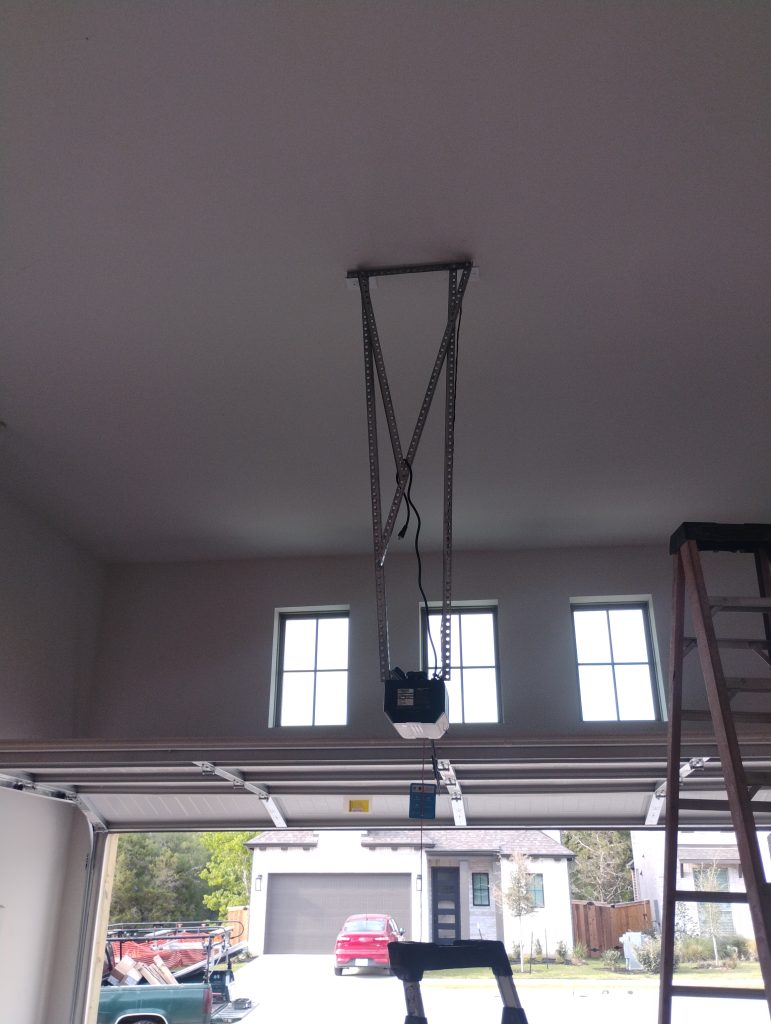
Direct Answer: Builders install standard-lift doors and trolley openers on long angle-iron drop brackets to cut material costs and simplify standard rough-ins. When home ceilings exceed 10 to 14 feet, a standard track leaves the assembly suspended far below the roof joists, wasting vertical storage space and creating leverage that requires careful sway bracing.
SAFETY WARNING: Modifying overhead garage door track geometry, raising track heights, or converting your system to accommodate a wall-mount opener requires altering high-tension torsion springs, lift cables, and counterbalance assemblies. These components store immense mechanical energy that can cause catastrophic injury or death if handled improperly. Always leave structural track adjustments and spring conversions to certified, insured garage door professionals.
The Architecture Behind Drop-Hung Overhead Openers
In modern residential construction, floor plans frequently incorporate soaring 10-foot to 14-foot garage ceilings to align with elevated interior ceiling heights or accommodate architectural exterior elevations. However, standard residential garage doors are typically 7 or 8 feet tall. Unless a high-lift track conversion is explicitly specified during the blueprint phase, builders install standard-radius horizontal tracks hung at door height, bridging the expansive vertical gap with extended lengths of perforated steel angle iron.
While an elongated suspension cage satisfies basic functionality, it presents notable drawbacks for homeowners seeking overhead ceiling clearance, vehicle lift installations, or clean aesthetics.
Key Issues Associated with Suspended Trolley Drops
- Loss of Usable Overhead Clearance: The suspended motor and perforated steel drop bracket cut through usable vertical volume, preventing the installation of overhead mezzanine storage racks or multi-vehicle mechanical lifts.
- Long-Arm Kinetic Leverage: Because the motor head hangs 4 to 6 feet beneath the structural ceiling joists, the push-pull torque of the trolley generates substantial rotational leverage. Without diagonal cross-bracing (forming a rigid triangular truss), the motor can sway, stressing ceiling fasteners.
- Obstruction of Architectural Elements: As seen in tall garages, long metal supports often visually obstruct upper clerestory or transom windows intended to flood the garage with natural light.
Evaluating Causes and Engineering Solutions
Homeowners faced with low-hanging opener brackets can explore modern retrofits to reclaim their garage volume and eliminate towering suspension hardware.
| Condition / Problem | Underlying Cause | Professional Solution |
|---|---|---|
| Opener dropped 3–6 feet on angle iron | Standard-lift track installed beneath a high ceiling to reduce initial build costs | Perform a high-lift track conversion to run tracks close to the ceiling deck |
| Center rail blocks car lifts or tall vehicles | Center-mount drawbar trolley requires horizontal ceiling clearance | Replace trolley opener with a side-mount (jackshaft) direct-drive operator |
| Suspension cage vibrates or sways during cycle | Insufficient lateral triangulated bracing on long vertical drops | Add structural diagonal angle-iron kickers to create a rigid three-dimensional truss |
| Upper transom windows blocked by metal struts | Straight-line opener installation ignores window placement | Relocate opener to a jackshaft configuration mounted directly on the torsion tube |
Troubleshooting and Upgrade Assessment Steps
If you are planning to modernize your high-ceiling garage and eliminate extended drop brackets, evaluate the following structural factors with a trained technician:
- Verify Ceiling Framing Alignment: Inspect whether the top plates of the drop brackets anchor into solid ceiling joists, trusses, or mere drywall anchors. Long drops demand lag screws driven squarely into structural wood.
- Check for Triangulated Bracing: Inspect your existing drop assembly. Long drops exceeding 24 inches must feature diagonal angle braces forming a triangle; simple vertical legs will eventually loosen under motor cycling.
- Assess Torsion Shaft Clearance: Check if your door uses standard front-mount torsion springs. A high-lift conversion requires custom-wound torsion springs, tapered commercial drums, and extended lift cables calibrated precisely to the new track rise.
- Confirm Side Wall Clearance: A wall-mounted jackshaft opener requires at least 8 to 10 inches of horizontal side clearance adjacent to the torsion spring tube and an accessible standard 115V outlet.