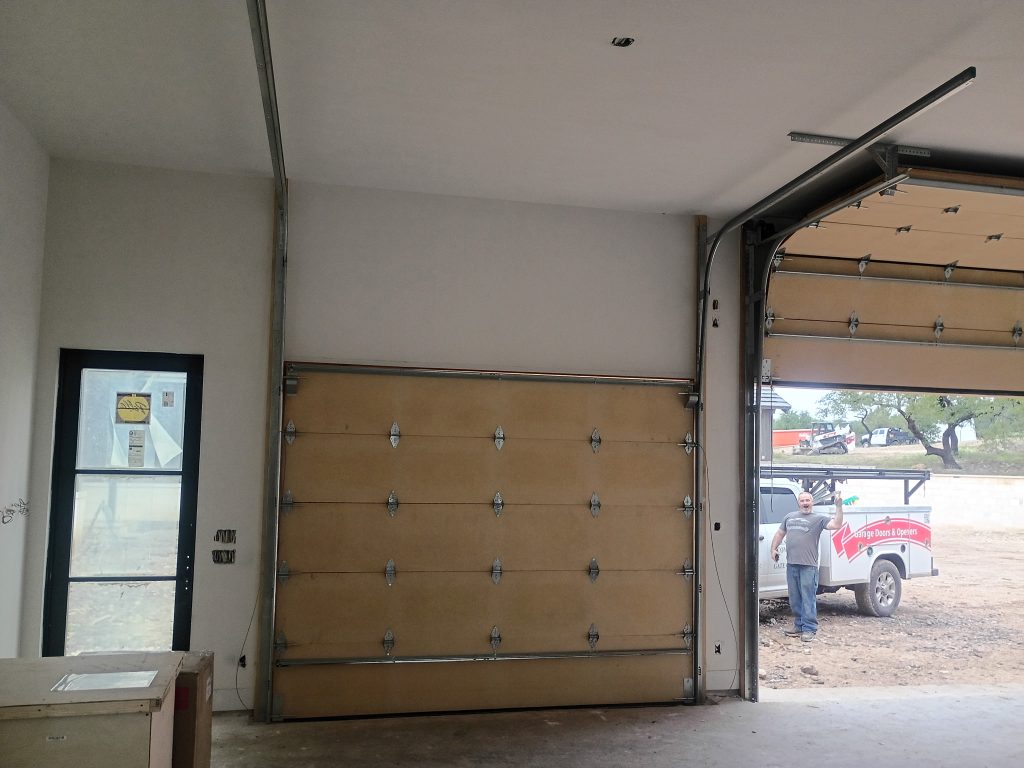
Your garage door utilizes a high-lift track configuration. Instead of immediately bending into horizontal tracks right above the door header, extended vertical tracks guide the door several feet higher along the wall before curving backward. This design takes full advantage of high ceilings to maximize usable overhead headroom and clear space.
SAFETY WARNING: High-lift garage door systems utilize specialized high-tension counterbalance springs, tapered drums, and heavy-gauge extended vertical tracks. Never attempt to adjust, repair, or modify high-lift tracks, cables, or torsion assemblies yourself. High-tension components can release violent, life-threatening energy if handled improperly. Always consult a certified garage door professional.
Understanding High-Lift Track Systems
In standard residential garages with standard 8-to-9-foot ceilings, overhead garage doors feature a radius curve situated roughly 12 to 15 inches above the door opening. As soon as the door begins opening, it quickly transitions from vertical to horizontal travel, riding suspended across the garage ceiling.
However, when a garage ceiling is 10, 12, or even 14+ feet tall—common in modern construction, custom workshops, and pole barns—standard horizontal tracks leave massive dead space overhead while slicing right through the middle of the room. A high-lift track conversion extends the vertical tracks upward so the door hugs the wall until it nears the ceiling before rolling back.
Why Builders and Homeowners Choose High-Lift Tracks
Extending vertical tracks provides several major practical benefits:
- Accommodating Automotive Lifts: Enthusiasts and mechanics frequently install high-lift doors so that a car on a two-post or four-post lift can be fully raised without impacting the garage door or its tracks.
- Unobstructed Overhead Storage: It keeps the center of the garage open for tall shelving, mezzanine lofts, or hanging racks.
- Accommodating Tall Vehicles: Oversized commercial vans, lifted trucks, or boats with wakeboard towers can enter and maneuver comfortably.
- Wall-Mounted Jackshaft Openers: High-lift doors almost always pair with wall-mounted direct-drive (jackshaft) openers, eliminating hanging ceiling rails, drop-down brackets, and center-mounted motors altogether.
Comparing Garage Door Track Configurations
| Track Style | Ceiling Height Needed | Primary Benefit | Counterbalance Component |
|---|---|---|---|
| Standard Lift | Door height + 12" to 18" | Cost-effective, fits standard 8′-9′ ceilings | Flat cable drums (standard) |
| High-Lift (Shown in photo) | Door height + 24" to 60"+ | Frees vertical space, fits vehicle lifts | Tapered high-lift cable drums |
| Full Vertical Lift | Double the door height | Door travels purely vertical, zero horizontal track | Steep spiral vertical drums |
Important Mechanical Requirements for High-Lift Doors
Converting to or maintaining a high-lift track is not just a matter of adding extra track segments. The physics of how the door’s weight shifts changes drastically:
- Tapered Cable Drums: Because the door stays vertical longer, it remains heavy on the springs for a longer portion of its travel. Tapered drums vary the mechanical leverage as the door rises, preventing the cables from throwing slack.
- Recalculated Torsion Springs: High-lift systems demand custom-engineered torsion springs calculated precisely to the door weight, door height, and exact inches of high-lift track.
- Spring Bumpers: Because high-lift doors roll onto relatively short horizontal tracks near the ceiling, heavy-duty push-down spring bumpers are required at the track ends to help push the door down when closing starts.