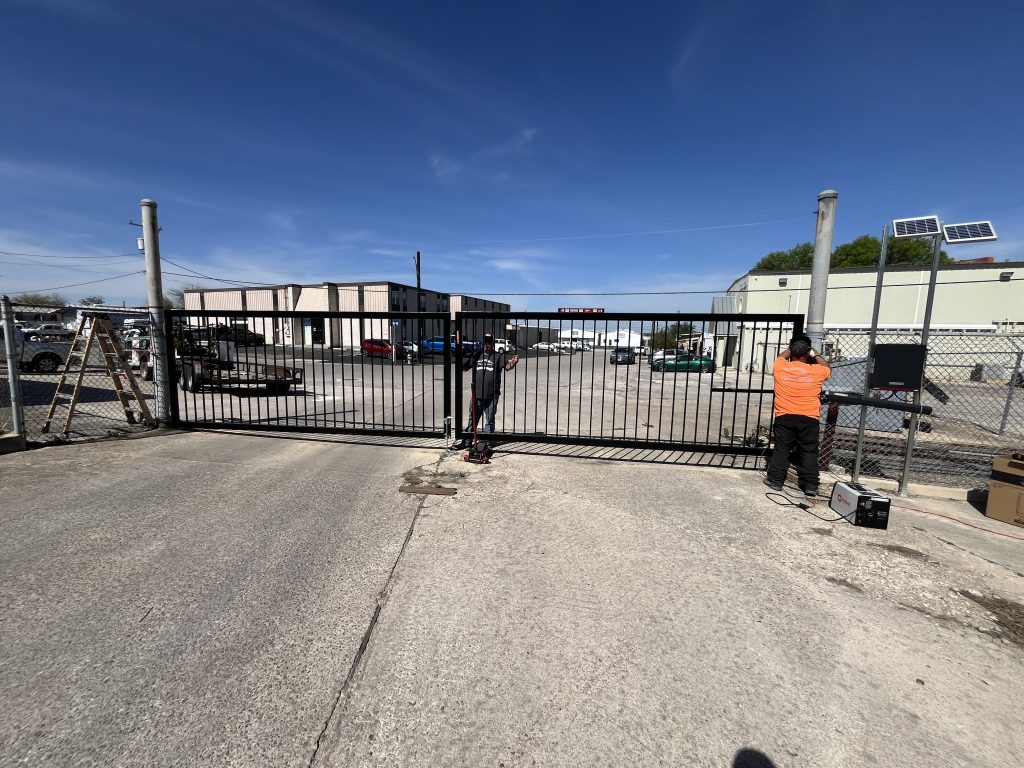
Commercial double swing gates sag and fail to meet in the center primarily due to worn hinge bearings, structural post deflection, foundation shifting, or fatigued mounting welds. Because heavy steel gate leaves exert continuous cantilevered torque on support posts, even slight hinge wear or post movement causes significant alignment drops at the center meeting point.
SAFETY WARNING: Heavy commercial steel swing gates weigh several hundred pounds per leaf and store dangerous kinetic and torsional energy. Never attempt to unbolt, jack, or weld sagging gate leaves on your own. A falling gate leaf can cause catastrophic crush injuries or death. Structural alignment, hinge replacement, and welding must always be performed by licensed commercial gate specialists.
Understanding Dual Swing Gate Geometry and Sag
Commercial bi-parting swing gates span wide security openings across distribution yards, storage facilities, and industrial complexes. Each leaf acts as a long cantilever arm anchored to an exterior steel pillar. The furthest tip of the leaf—where the two panels meet to latch or lock—amplifies any minute mechanical shift at the hinge pivot. If an anchor post shifts by just one-sixteenth of an inch, the gate’s center meeting point can drop an inch or more, causing dragging, binding, latch failures, and severe strain on automated swing operators.
Common Causes vs. Engineered Solutions
Restoring a bi-parting gate system requires assessing both the static steel framework and the automated actuation geometry. The table below outlines why double swing gates lose alignment and how commercial technicians resolve them:
| Root Cause of Gate Sag | Operational Symptoms | Professional Engineered Solution |
|---|---|---|
| Worn Barrel Hinge Bushings | Gate squeals, drops downward, drags concrete at center | Replace with heavy-duty sealed bearing or greaseable weld-on barrel hinges |
| Post Deflection or Foundation Shift | Posts lean slightly inward under heavy cantilever weight | Excavate and reinforce concrete footings, or install overhead tie beams and ground braces |
| Fatigued Hinge Welds | Cracking sound during swing cycle, visible weld tears | Jack gate leaf, grind failed welds, re-weld with structural gusset reinforcements |
| Mechanical Operator Out of Sync | One leaf reaches center before the other, jamming stops | Recalibrate actuator travel limits, dual-gate delay settings, and positive hard stops |
Visual Troubleshooting Checklist for Facility Managers
Before dispatching a commercial technician, facility managers can conduct a non-invasive physical inspection to document structural wear:
- Check the Center Gap: Measure the vertical gap between leaves when fully closed. A V-shaped gap (wider at the top, touching at the bottom) indicates post lean or lower hinge wear.
- Inspect Ground Clearance: Look for scrape marks or dragging gouges along the driveway surface near the gate’s center radius.
- Inspect Hinge Plates: Check the weld beads connecting the barrel hinges to the vertical post for hairline cracks, rust bleeding, or metal deformation.
- Examine Post Plumbness: Place a 4-foot magnetic level on the support posts to see if ground shifting or vehicle impacts have tilted the structural posts.
- Test Operator Arm Pins: Observe whether the linear actuator or articulating arm wiggles excessively at pivot brackets during initial push.
Why Professional Realignment is Essential
Realigning commercial bi-parting gates is not as simple as adjusting an off-the-shelf turnbuckle. Certified gate technicians utilize industrial leveling jacks, precision welding equipment, and laser levels to plumb support posts, restore squareness, and distribute leaf weight evenly across heavy-duty hinge pivots. Once leveled, automated operators must have their clutch limits, stall forces, and safety loop detectors re-certified to comply with UL 325 safety standards.