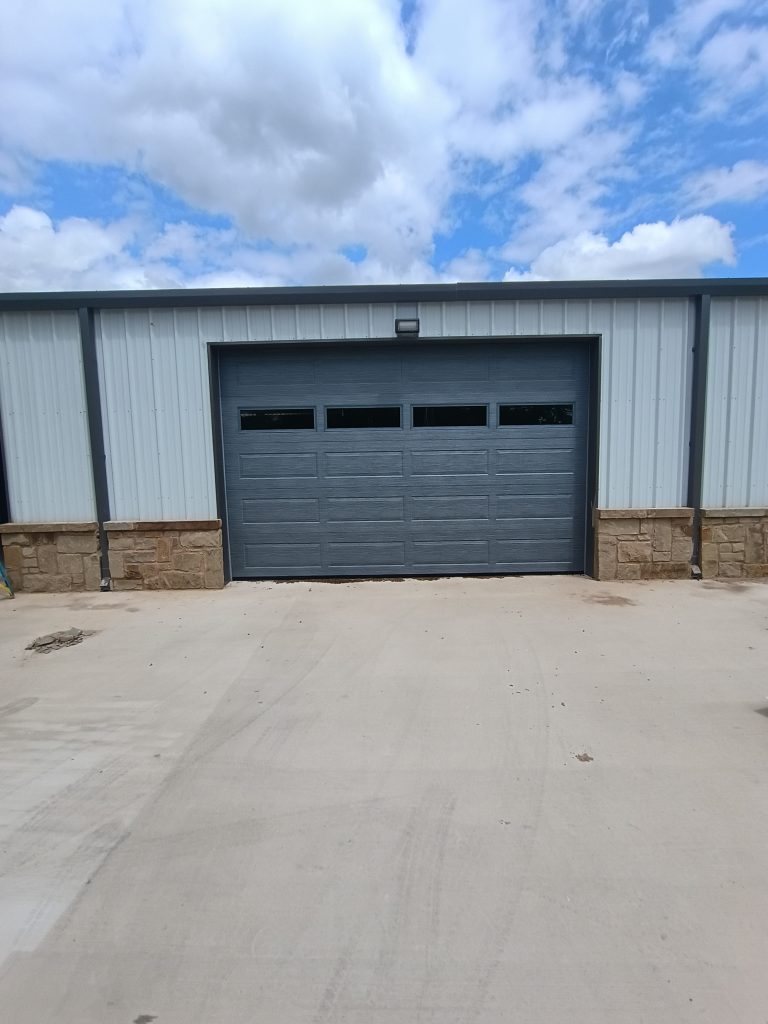
A visible gap at the top header of your metal building garage door typically stems from improperly calibrated top roller fixtures, incorrect opener travel limits, missing header flap weatherstripping, or misaligned vertical tracks. Fine-tuning the adjustable top roller carriers pushes the top section flush against the perimeter seal without bending the panel.
SAFETY WARNING: Overhead doors installed on pre-engineered steel buildings are heavy and powered by extreme counter-balance spring tension. Never loosen, adjust, or tamper with torsion springs, lifting cables, or bottom roller brackets. If your door does not seal correctly or sticks in the tracks, contact a trained commercial garage door technician to prevent severe personal injury or property damage.
Understanding Header Alignment in Metal Buildings
Unlike standard wood-framed residential homes, metal buildings, barndominiums, and steel workshops utilize rigid steel C-channel, structural tubing, or sheet metal trim around garage openings. Because steel framing does not absorb moisture or give under pressure like dimensional lumber, overhead door tracks must be aligned with exact precision. When an overhead door closes completely at the floor but leans backward away from the top jamb, drafts, rain, insects, and light quickly infiltrate your shop.
1. Misadjusted Top Roller Fixtures
The top section of your garage door uses adjustable top roller brackets rather than standard stationary hinges. These brackets have slotted slides that allow a technician to push the top panel closer to or farther away from the exterior header wall. If the carrier is set too far back into the room, the top panel will rest inches away from the perimeter seal even when the door is fully shut.
2. Trolley Opener Arm Geometry and Down-Travel
If your overhead door is operated by a drawbar trolley opener, the angle and push rod travel of the J-arm dictate where the top panel stops. If the opener down-limit shuts off before the arm fully cams over, or if the opener rail is mounted too high above the header, the arm pulls upward on the top panel instead of pushing it forward against the opening frame.
3. Missing Top Header Weatherstripping
Commercial-style steel openings often require a dedicated top flap seal or vinyl perimeter weatherstrip with a wider dual-lip profile. Without an oversized top flap seal designed specifically for metal building trim profiles, subtle framing variations will produce a daylight gap across the top section.
Causes vs. Solutions for Top Header Gaps
| Observed Issue | Probable Root Cause | Professional Solution |
|---|---|---|
| Top section tilts inward, daylight visible across top edge | Top roller slide brackets positioned too far inward on track | Loosen bracket carrier nuts, push panel gently forward against seal, retighten |
| Door stops before top panel compresses against header seal | Opener down-travel limit set short or straight arm angle too steep | Recalibrate opener travel limits and adjust opener drawbar arm geometry |
| Gap appears only in center of header | Header sag or metal trim bowing outward across wide span | Install heavy-duty dual-lip top flap weatherstrip or structural header stiffener |
| Top edge seals tightly on one side but gaps on the other | Horizontal tracks out of square or door out of level | Square horizontal track hangars and balance torsion cable drum tension |
Troubleshooting Steps for Homeowners
- Inspect from the Exterior: Close the door fully and inspect the top trim. Note whether the gap runs uniformly across the entire panel or occurs only at the corners or center.
- Perform the Light Test: Turn off inside workshop lights during daylight hours to see exactly where daylight filters through the perimeter seals.
- Check Opener Arm Push: Observe the operator arm as the door completes its closing cycle. The arm should push the top panel firmly into the header. If it relieves pressure at the end of the stroke, the travel limits need adjustment.
- Inspect Top Roller Slides: Check if the top roller stems are seated properly within the track groove and ensure the bracket screws have not vibrated loose from building vibration.
When to Call a Professional
If adjusting surface-level stops or perimeter flap seals does not fix the gap, the problem often involves track pitch, cable drum timing, or spring tension balance. Because heavy steel panels can shift suddenly if track fasteners are loosened under load, always consult a licensed overhead door specialist to perform comprehensive track and hardware alignments.