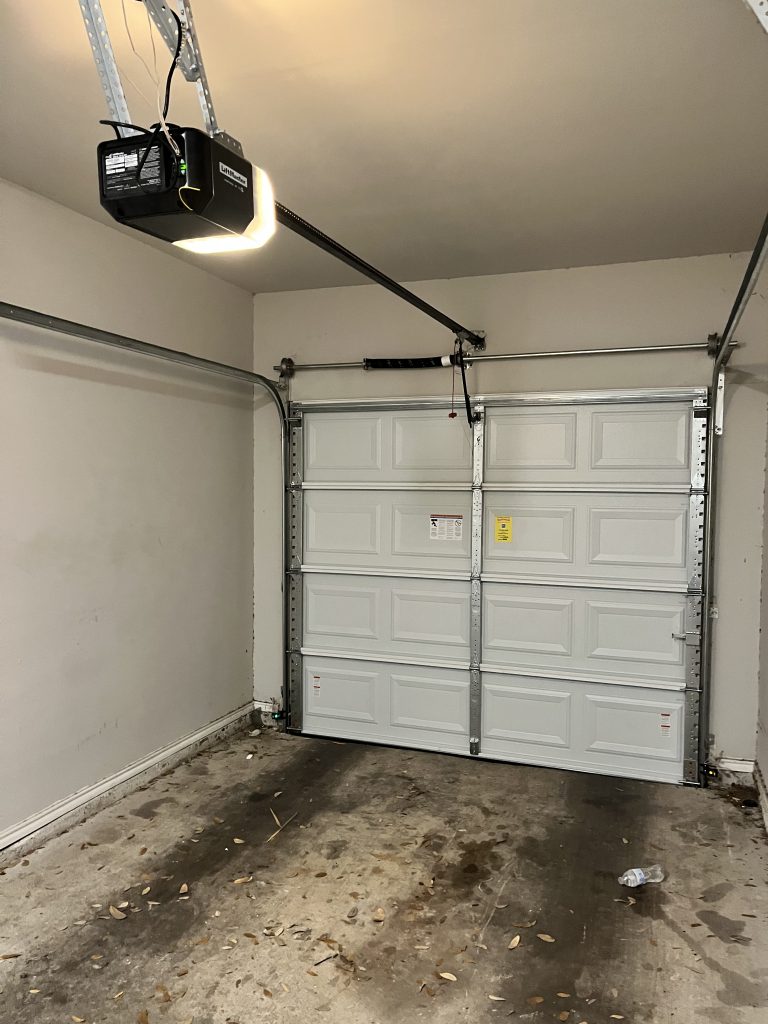
Single-car garage doors often utilize a single torsion spring because their lighter weight (typically 120 to 160 pounds) requires less rotational torque to balance than wide double doors. Builders install single springs primarily to minimize material costs, although dual-spring setups provide significantly smoother operation, longer lifespan, and essential fail-safe redundancy.
SAFETY WARNING: Garage door torsion springs operate under extreme mechanical tension capable of inflicting catastrophic blunt-force injuries. Never attempt to wind, loosen, adjust, or replace torsion springs, cables, or bottom brackets yourself. All counterbalance repairs must be performed exclusively by certified professional garage door technicians.
The Engineering Behind Single Torsion Spring Systems
When builders construct standard residential single-car garages—typically housing 8×7 or 9×7 foot doors—they calculate the exact counterbalance weight needed based on the door’s panel gauge and lack of heavy back-insulation. Because an uninsulated or lightly insulated single-car door weighs significantly less than a 16-foot double door, a single high-tensile steel spring mounted centrally or offset on the torsion tube produces sufficient inch-pounds of torque per turn (IPPT) to balance the assembly.
While mechanically functional, a single-spring configuration is often an exercise in value engineering. A single spring achieves the minimum standard cycle life (usually 10,000 cycles), but concentrates all lifting torque across one point on the torsion shaft, which can accelerate operational wear over time.
Single Spring vs. Dual Spring: Causes and Solutions
Understanding how a single-spring configuration compares to a dual-spring system helps you determine whether a conversion is appropriate when replacement time arrives.
| Operational Factor | Single Spring System | Dual Spring Conversion |
|---|---|---|
| Failure Redundancy | Zero. When the spring breaks, the door drops dead weight instantly. | Partial. If one breaks, the second holds partial tension, preventing total drop. |
| Opener Gearbox Strain | High when spring fatigues, risking stripped drive gears. | Low and balanced across both sides of the torsion shaft. |
| Shaft and Bearing Wear | Uneven radial torque can cause premature center bushing wear. | Evenly distributed torque minimizes shaft deflection and vibration. |
| Cycle Life Rating | Standard baseline (approx. 10,000 open/close cycles). | Can be configured for extended life (20,000 to 50,000+ cycles). |
Troubleshooting Symptoms of a Fatigued Single Spring
Because there is no secondary spring to share the load, a failing single torsion spring will cause noticeable operational changes before it snaps completely:
- The Opener Struggles or Reverses: If your electric opener hums, strains, or immediately halts and reverses during the first foot of travel, the single spring has lost its required tension.
- Heaviness in Manual Mode: Disconnect the opener via the red emergency release cord. If lifting the door manually requires significant physical effort, the spring has fatigued. A balanced door should lift smoothly with one hand.
- Jerky or Crooked Travel: Uneven torque transfer from a single offset spring can cause the door to shudder or pull slightly to one side as the rollers navigate the track curve.
- Elongated or Separated Coils: Visual inspection of the spring above the door may reveal slight deformation, rust accumulation, or coil stretching.
Should You Convert to Dual Springs?
When your single spring eventually reaches its fatigue limit and breaks, you do not have to replace it with another single spring. Upgrading to a dual-spring assembly during professional service is a common and smart enhancement. Dual springs distribute rotational torque evenly across both cable drums, ensuring level door tracking, reducing motor fatigue on your electric opener, and ensuring your vehicle is not trapped inside if one spring fails.