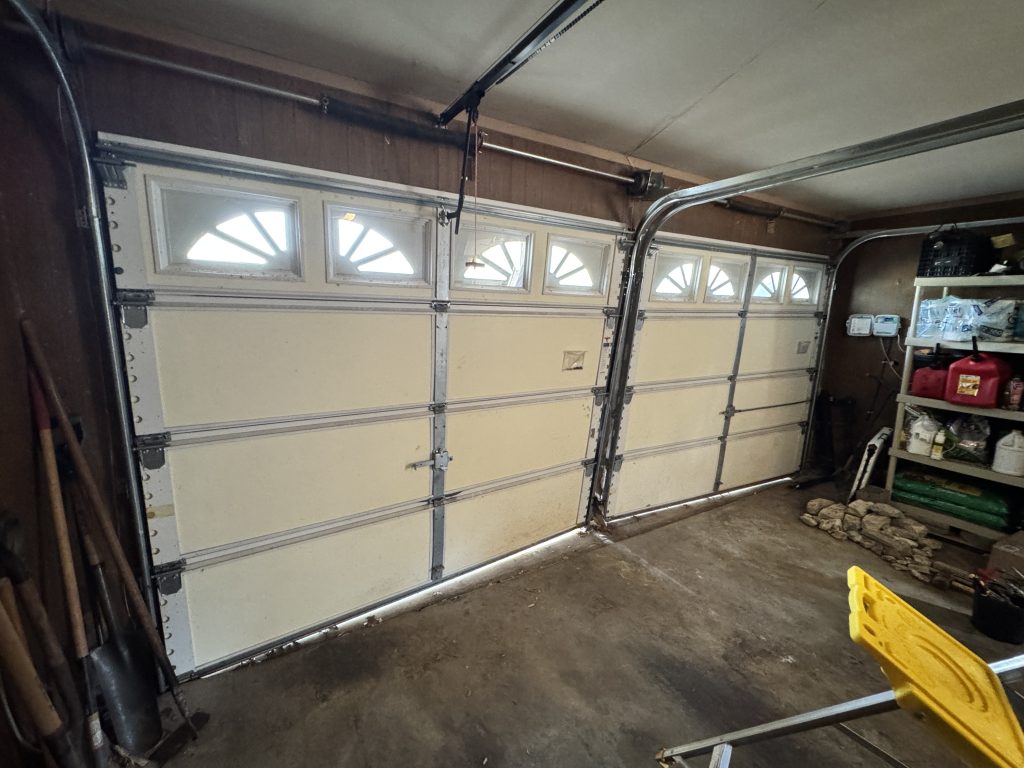
Daylight leaking beneath your closed garage door typically indicates a deteriorated bottom rubber astragal seal, an unlevel or settled concrete foundation, or improper track and limit adjustments. Left unresolved, these gaps allow pests, moisture, and drafts inside, reducing insulation efficiency and potentially signaling cable or leveling issues that require professional realignment.
SAFETY WARNING: Never attempt to adjust, loosen, or remove the bottom corner brackets of your garage door. These brackets are under extreme tension from the counterbalance lift cables. Mishandling them can result in violent release, catastrophic structural damage, or severe personal injury. All cable and bracket adjustments must be handled exclusively by certified technicians.
Common Reasons Daylight Appears Under Closed Garage Doors
A closed garage door should create a snug, uniform barrier against the concrete apron. When slivers or wide patches of daylight appear across the threshold, one or more key components have lost their integrity or alignment.
1. Worn, Flattened, or Dry-Rotted Bottom Astragal
The flexible rubber or vinyl seal attached to the bottom aluminum retainer takes constant compression, exposure to temperature extremes, road salts, and sun. Over years of service, the seal flattens out, becomes brittle, cracks, or shrinks, losing its ability to fill the contour of the floor.
2. Uneven or Settling Concrete Floor
Concrete slabs naturally settle, shift, or crack over time due to ground movement, freeze-thaw cycles, and heavy vehicle traffic. If one side of the apron drops even a half-inch lower than the other, standard factory bottom seals cannot bridge the gap without specialized oversized seals or threshold adjustments.
3. Misaligned Vertical Tracks or Door Imbalance
If the tracks are out of plumb or one lift cable has slipped or stretched, the door will sit cockeyed when closed. This leaves a wedge-shaped gap of daylight on one side while the other side presses firmly against the concrete.
4. Incorrect Opener Down-Travel Limits
If an automatic opener is calibrated to stop its downward travel too early, the door will halt before the bottom weatherstrip can compress fully, leaving a uniform horizontal line of daylight across the entire opening.
Causes vs. Solutions
| Underlying Cause | Identifiable Symptoms | Recommended Solution |
|---|---|---|
| Deteriorated Rubber Seal | Cracked, brittle, or flattened rubber; visible light along center or edges. | Replace with heavy-duty T-style rubber or bulb weatherstrip. |
| Uneven Concrete Slab | Wedge-shaped light gap; puddling water on one side during rain. | Install an oversized heavy-duty seal or floor-mounted rubber threshold barrier. |
| Cable Tension Imbalance | Door hangs crooked; uneven gap across the floor; door binds during travel. | Professional leveling, cable reset, and torsion system rebalancing. |
| Travel Limit Miscalibration | Uniform gap across the entire width; motor shuts off smoothly before full seal. | Recalibrate opener down-force and travel limits to ensure proper rubber compression. |
Safe Homeowner Troubleshooting Steps
- Perform a Daylight Audit: Turn off interior garage lights during a sunny day, close the door, and note whether the gap is uniform, isolated to corners, or angled.
- Inspect the Rubber Seal: Check for stiff, missing, or chewed rubber sections without pulling or unbolting the metal brackets.
- Check for Floor Obstructions: Clear away dirt, stones, or debris accumulated along the floor channel that might prevent the door from bottoming out evenly.
- Check Level with a Bubble Level: Place a 4-foot level along the bottom section to determine if the door itself is out of level or if the concrete floor has settled unevenly.
If your door sits crookedly or replacing the bottom seal does not resolve the gap, contact a licensed garage door technician to inspect the track plumb, cable tension, and counterbalance balance safely.