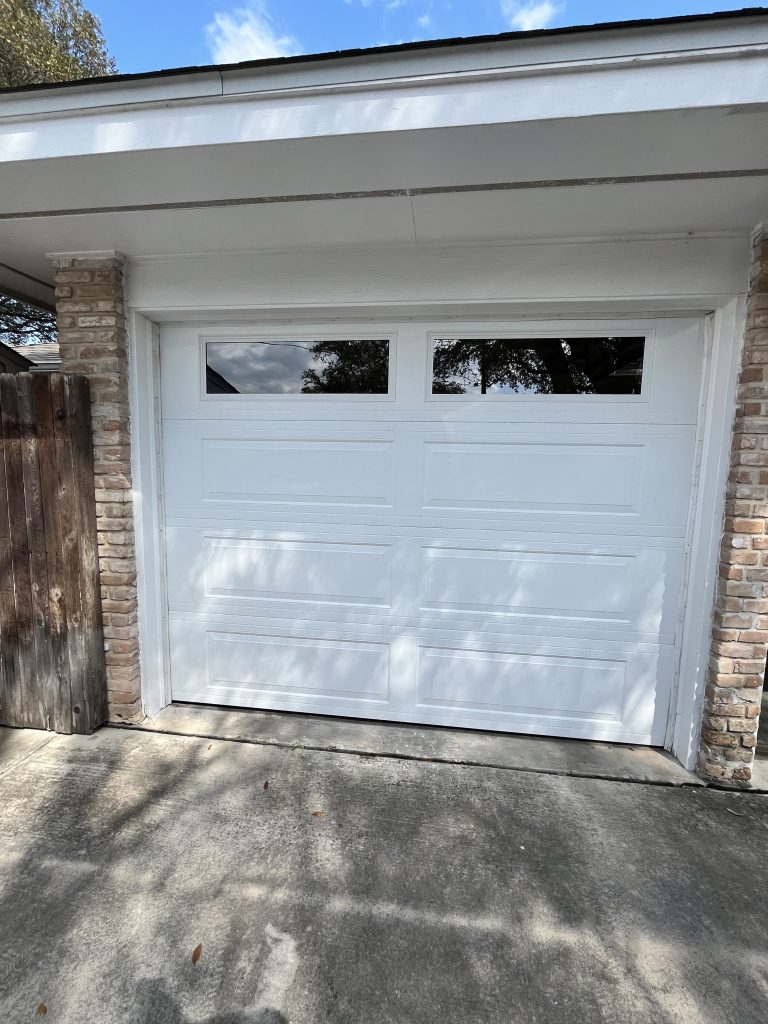
A garage door lifts unevenly with side-stacked windows because the glass inserts concentrate dead weight along one side of the sections. Without counter-calibrated torsion springs, this localized imbalance pulls the door off-level, causing roller binding, friction in the vertical tracks, premature cable slack, and excessive strain on the automatic opener drive gear.
WARNING: Garage door counterbalance systems operate under extreme mechanical tension. Torsion springs, drums, bottom brackets, and lift cables carry enough stored energy to cause severe personal injury or death. Never attempt to wind, loosen, or adjust springs or lift cables yourself. All counterbalance adjustments must be performed by a qualified professional technician.
How Side-Mounted Windows Impact Door Counterbalance
Modern residential architecture frequently incorporates contemporary asymmetrical window arrangements—such as stacking glass inserts exclusively on the left or right side of a standard raised-panel steel door. While visually striking, glass, decorative frames, and glazing inserts weigh significantly more than the insulated steel or aluminum sections they replace.
Standard garage door torsion assemblies are designed to distribute lifting force symmetrically across both drums. When extra weight sits entirely on one vertical column, the lighter side begins to rise faster than the heavier side. This creates a phenomenon known as “racking,” where the door twists slightly within the opening rather than ascending horizontally.
Common Causes vs. Professional Solutions
Addressing an uneven lift requires diagnosing whether the issue stems from spring calibration, cable drum sizing, or track friction.
| Root Cause | Observable Symptom | Professional Solution |
|---|---|---|
| Asymmetrical Dead Weight | Door hangs crooked when partially open; one side drags off the floor first. | Calculate precise weight offset and install custom-calibrated torsion springs. |
| Uneven Cable Tension | One lift cable goes slack while the other stays taut during initial motor pull. | Reset drum timing, level bottom brackets, and synchronize cable lengths. |
| Heavy-Side Roller Binding | Loud squealing, grinding, or track pinching along the window column. | Realign vertical tracks, adjust back-hangs, and install commercial-grade nylon rollers. |
| Opener Trolley Stress | Opener motor hums loudly, stutters, or reverses due to safety limit triggers. | Rebalance door manual travel and recalibrate opener travel and force limits. |
Troubleshooting an Off-Balance Asymmetrical Door
Before calling a licensed service technician, you can perform several safe visual inspections to identify the source of the misalignment:
- Check the Closed Reveal: Inspect the gap between the bottom weather seal and the concrete driveway when closed. If the window side compresses flat while daylight shows beneath the opposite side, the door is hanging unevenly.
- Observe the Initial Lift: Stand back and activate the opener. Watch the bottom panel. If one bottom corner lifts 1 to 2 inches before the other moves, the torsion assembly lacks symmetrical counterbalance.
- Inspect Track Clearances: Examine the vertical tracks on both sides. The rollers on the weighted side often push tightly against the outer track flange, creating visible steel shaving or black dust.
- Listen for Mechanical Popping: A sharp popping sound near the top header during travel typically indicates the cable is spooling unevenly across the cable drum grooves.
Why Professional Counterbalance Calibration Is Essential
Compensating for asymmetrical windows is not as simple as adding extra quarter-turns to an existing torsion spring. In many cases, professional technicians must install split-spring configurations or asymmetrical wire-gauge springs to deliver differential torque to each drum. Attempting to force an uneven door open with an electric opener will rapidly strip the drive gear, bend vertical tracks, and risk throwing cables off their drums.