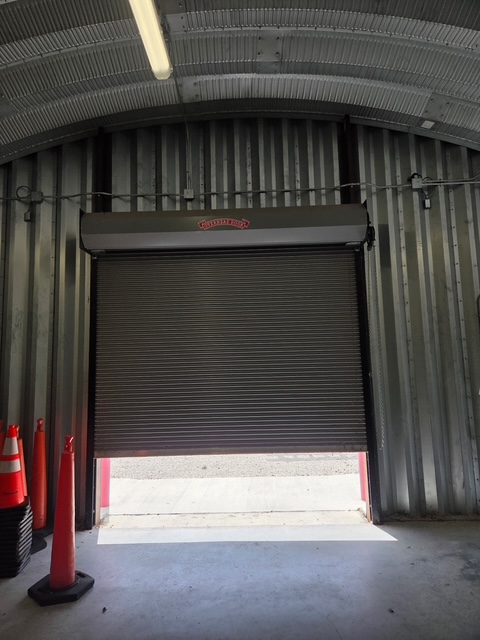
Direct Answer: A commercial roll-up door stuck partially open is typically caused by internal barrel spring tension loss, guide track obstructions, misaligned side guides, or a jammed manual chain hoist mechanism. Because industrial coiling steel doors operate under severe spring counterbalance tension, professional inspection and realignment are required to safely restore full operation.
SAFETY WARNING: Commercial roll-up doors utilize heavy-gauge steel curtains and high-torque internal barrel springs under extreme mechanical tension. Never attempt to adjust counterbalance springs, loosen guide brackets, or force a stuck roll-up curtain manually. Doing so can cause catastrophic curtain drops or spring release, resulting in severe crushing injuries or death. Always contact a certified commercial door technician.
Understanding Commercial Roll-Up Door Operation
Unlike standard residential sectional overhead doors, industrial coiling steel doors roll directly around an overhead barrel assembly protected by a steel hood. The curtain consists of interlocking metal slats that glide vertically within heavy-duty steel side guides. When properly balanced, internal torsion springs housed inside the barrel assembly counterbalance the door’s substantial weight, allowing effortless manual chain hoist or motorized operation.
Common Causes for a Stuck Roll-Up Coiling Door
When an industrial roll-up door stops midway through its cycle, several underlying mechanical factors are commonly responsible:
| Observed Issue | Underlying Cause | Professional Solution |
|---|---|---|
| Curtain stops midway and feels heavy | Loss of torsion balance inside the barrel assembly | Professional spring retensioning or internal barrel replacement |
| Squealing sound; curtain binds in tracks | Misaligned, dented, or unlubricated guide channels | Track realignment, guide channel cleaning, and heavy-duty lubrication |
| Chain hoist spins without lifting door | Stripped gear reduction box or broken drive pin | Hoist gearbox rebuild or drive sprocket replacement |
| Slats crooked or jumping out of guides | Endlocks damaged or slat deflection due to impact | Sectional slat replacement and endlock repair |
Safe Troubleshooting Checklist for Warehouse Managers
Before calling for professional service, facility operators can perform these safe visual checks:
- Inspect the Side Guides: Visually examine the vertical tracks from ground level for dents, debris, or fork truck impact damage.
- Check the Hand Chain: Ensure the manual hand chain is not bound, tangled, or caught on nearby building conduit.
- Listen for Binding: When engaging the operator, listen for metal-on-metal grinding which indicates a dry or pinched guide assembly.
- Check for Slat Damage: Inspect the curtain for separated slats or missing endlocks that prevent smooth roll-up into the hood enclosure.
Why Professional Service is Mandatory
Commercial roll-up doors carry immense weight suspended entirely from overhead mounting brackets. Attempting DIY repairs on barrel assemblies, counterweights, or release mechanisms presents severe hazards. Licensed technicians possess specialized winding bars, heavy-duty hoist equipment, and certified training to safely service high-tension commercial rolling systems.