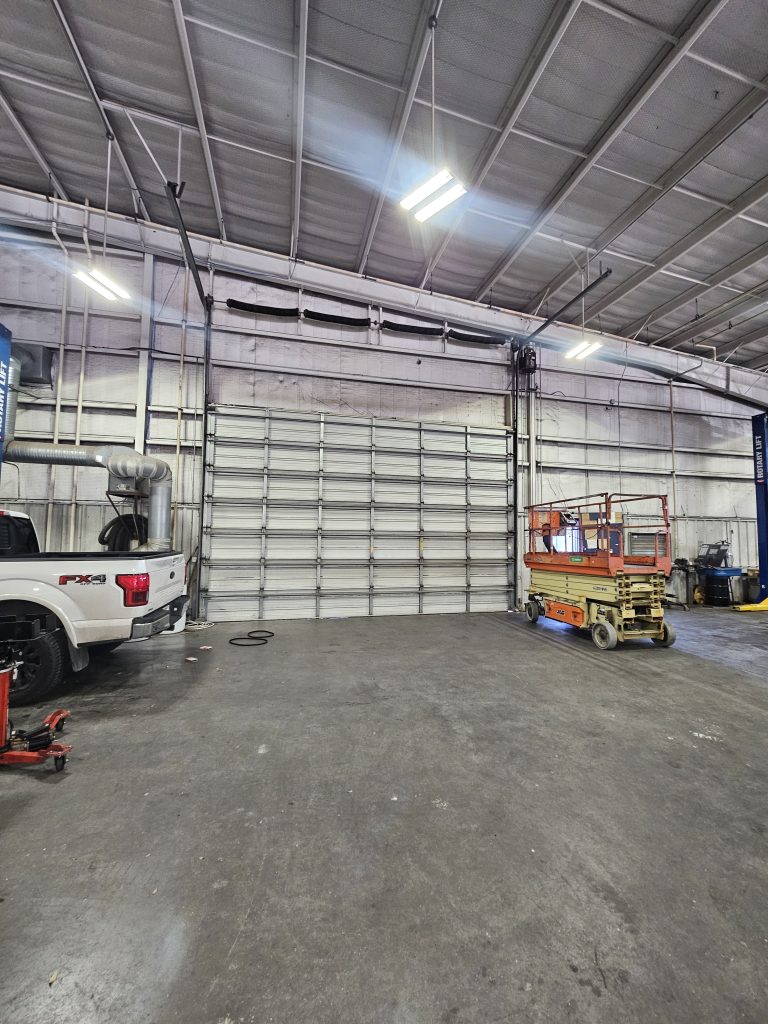
Direct Answer: A commercial overhead door becomes stuck or derails primarily due to snapped lift cables, damaged or misaligned vertical tracks, worn commercial-grade rollers, or broken high-tension torsion springs. Because commercial sectional doors weigh hundreds of pounds, any imbalance causes immediate binding, requiring immediate certified technician intervention to prevent structural collapse.
SAFETY WARNING: Commercial sectional doors operate under extreme counterbalance tension and heavy mechanical loads. Never attempt to adjust, release, or repair torsion springs, bottom brackets, or cables yourself. Doing so can release lethal kinetic force resulting in catastrophic injury or death. Always contact a certified commercial door specialist.
Understanding Commercial Overhead Bay Door Systems
Commercial overhead doors in warehouses, service bays, and industrial facilities undergo continuous duty cycles. Unlike residential doors, these heavy-gauge steel systems frequently utilize high-lift or full vertical-lift track configurations to maximize vertical clearance for vehicle lifts and heavy machinery. The sheer mass of these multi-panel assemblies requires heavy-duty torsion springs, reinforced commercial tracks, and aircraft-grade steel lift cables functioning in precise synchronization.
Key Signs of Commercial Door Distress
- Asymmetrical Lifting: One side of the door pulls higher than the other, indicating a broken cable or drum slippage.
- Grinding or Squealing Noises: Heavy friction caused by bent tracks, dry roller bearings, or shaft misalignment.
- Gaps Between Panels: Damaged commercial hinges or bent horizontal reinforcing struts binding the sections.
- Motor Stalling or Reverse Cycling: Commercial operators detecting excess resistance due to counterbalance spring failure.
Visual Troubleshooting Checklist for Facility Managers
Before calling for emergency service, facility operators can perform a non-contact visual audit to identify the source of the malfunction safely from ground level:
- Inspect the Track Alignment: Check for physical bends, impact dents from forklifts or vehicles, and loose mounting brackets along the vertical and horizontal angle iron.
- Check Counterbalance Springs: Look at the center shaft above the door opening. A split or gap in the heavy torsion coil confirms a broken spring.
- Observe Cable Position: Ensure lift cables are seated properly within the grooves of the cable drums and are not frayed, slack, or unspooled.
- Examine Photo-Eye and Sensing Edges: Clear debris, dirt, or dust obstructing infrared safety sensors or bottom-edge safety reverse switches.
- Verify Power Supply: Check industrial 3-phase or single-phase disconnect switches, operator control boards, and wall stations.
Common Bay Door Issues: Causes vs. Solutions
| Symptom / Cause | Operational Impact | Professional Solution |
|---|---|---|
| Impact Damage (Forklift/Vehicle) | Bent lower panels, popped rollers, and warped tracks locking the door. | Panel replacement, track realigning, and commercial hinge rebuilding. |
| Torsion Spring Fatigue | Operator cannot lift door; excessive weight locks system down. | High-cycle commercial spring replacement and shaft re-balancing. |
| Cable Off-Drum (Thrown Cable) | Door jams at an angle; risk of catastrophic section drop. | Securing door with lift equipment, cable reset, and drum re-tensioning. |
| Worn Steel Rollers | Excess drag, roller popping out of track under load. | Installation of heavy-duty sealed commercial bearing rollers. |
Why Professional Commercial Repair is Mandatory
Servicing large industrial doors requires scissor lifts, specialized high-torque winding bars, and commercial-grade rigging equipment. Attempting to force an off-track commercial door down or manipulating its hardware without proper mechanical support can drop hundreds of pounds of steel instantly. Certified technicians have the expertise to secure the door safely, balance the counterweight system, and ensure OSHA-compliant operational safety.