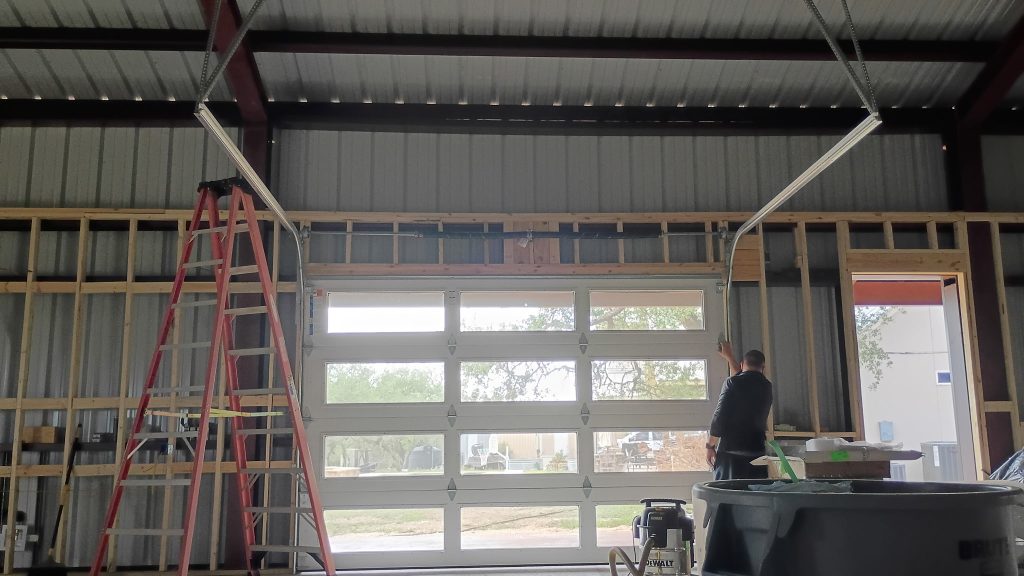
Direct Answer: Overhead garage door tracks shake and sway in a pole barn when long drop-hangers lack lateral sway bracing, rafters flex under wind load, or track fasteners loosen in wood framing. In high-ceiling steel buildings, unbraced vertical angle drops allow excessive horizontal movement, causing roller binding, abnormal wear, and potential derailment during door travel.
Safety Warning: Garage door horizontal tracks support hundreds of pounds of moving door weight. Overhead track failures, loose hanging iron, and associated torsion spring counterbalances pose severe crush and impact hazards. Never attempt to loosen track brackets, adjust spring tension, or dismantle hanging iron while the door is under load; always call a trained commercial garage door specialist.
Understanding Overhead Track Suspension in High-Ceiling Metal Buildings
Pre-engineered metal buildings, barndominiums, and pole barns present unique installation conditions for sectional garage doors. Unlike standard residential garages with eight-to-ten-foot ceilings, agricultural and commercial shops often feature cathedral trusses, steel I-beams, and ceiling heights exceeding fourteen to twenty feet. When standard-lift doors are installed in these tall spaces without high-lift conversions, technicians must span several feet of open space between the roof purlins and the horizontal tracks using perforated angle iron.
Without sufficient mechanical stabilization, these lengthy vertical drops act as pendulums. As the door rolls backward, vibration from the motor and the shifting weight of heavy glass or insulated panels causes the tracks to shimmy side to side. Over time, this movement distorts the door opening geometry, pops rollers from their races, and stresses your automatic opener arm.
Key Causes of Track Instability in Pole Barns
1. Missing Diagonal “Kicker” Braces
Vertical angle iron supports horizontal tracks against gravity, but it provides almost zero resistance to lateral (side-to-side) or longitudinal (front-to-back) movement. Professional installations require triangular sway bracing—often called diagonal “kickers.” When installers skip these 45-degree stabilizing struts between the track hanger and the roof framing, the horizontal tracks flex outward every time the door passes through the radius.
2. Inadequate Framing and Sub-Framing Flex
In post-frame construction, rough openings are framed with nominal dimensional lumber (such as 2×6 or 2×8 wood jambs) anchored to steel uprights or wood posts. If the jamb brackets, header pads, or back-hang points are attached to unbacked metal siding or poorly anchored dimensional wood, structural flex allows the entire track assembly to vibrate in unison.
3. Track Misalignment and Roller Drag
Horizontal tracks must be installed perfectly level and square across the diagonal measurements. If one track is out of parallel by even a half-inch, rollers drag hard against the track wall. This uneven friction transfers severe vibration directly into the hanging brackets rather than allowing smooth, silent travel.
Track Sway Causes vs. Recommended Professional Solutions
| Root Cause | Operational Symptom | Professional Solution |
|---|---|---|
| Drop-hangers exceed 24 inches without bracing | Visible side-to-side track wobble as panels roll back | Install engineered diagonal angle-iron sway braces to establish triangular rigidity. |
| Out-of-square track geometry | Loud squeaking, roller binding, or motor hesitation | Laser-level and cross-measure tracks from jambs to back-hangs; adjust track spread. |
| Loose fasteners in wood jambs or rafters | Clicking sounds, rattling brackets, frame deflection | Torque or replace structural lag bolts; install solid wood blocking where needed. |
| Improper lift track selection for ceiling height | Excessively long drops spanning empty vertical space | Retrofit the system with high-lift or vertical-lift track conversions. |
Signs Your Overhead Tracks Require Immediate Professional Service
- Visual Sway Exceeding One-Quarter Inch: Watch the rear ends of your horizontal tracks as the door transitions into the horizontal plane. Any noticeable swaying indicates missing lateral support.
- Rollers Popping Out of Track Channels: If a roller slips out of the track throat, the door panel can collapse downward instantly under immense weight.
- Bowed or Bent Perforated Angle: Light-duty steel angle iron that bends or curves under dynamic movement cannot safely support the door over repeated cycles.
- Loose Screws or Sheared Lag Bolts: Check the ground below back-hangs for fallen hardware caused by persistent mechanical vibration.
If your pole barn garage door tracks wobble, shake, or make grinding noises during transit, contact a certified garage door technician to inspect the back-hang bracing and ensure your overhead tracks remain secure, true, and safe.