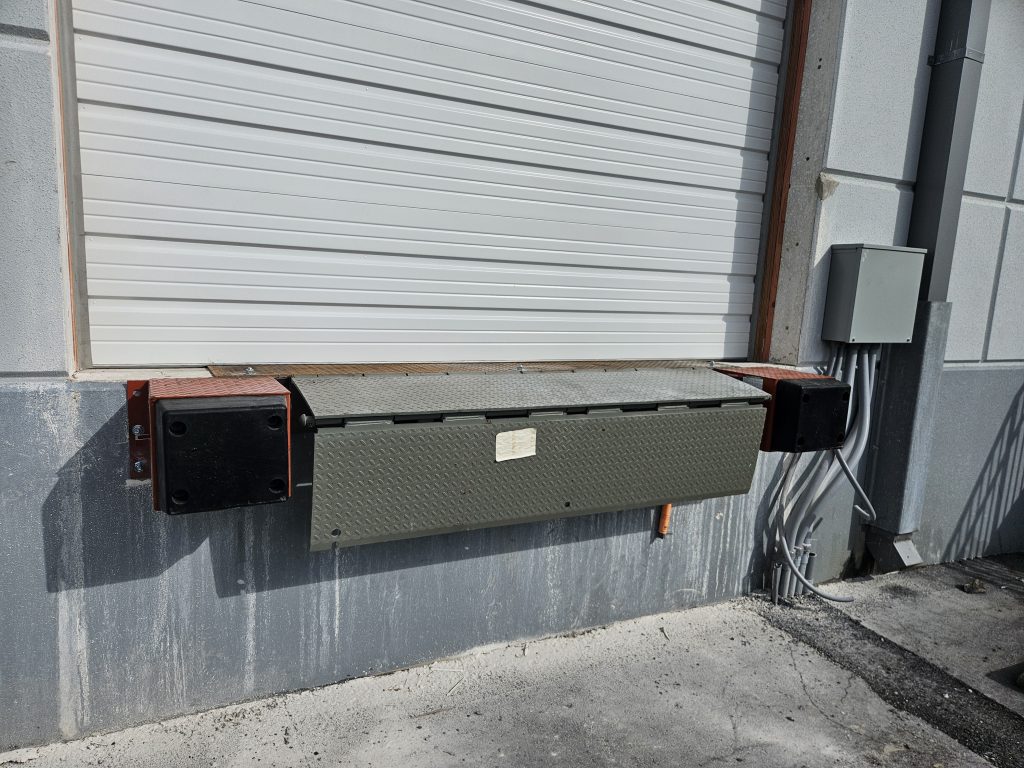
Direct Answer: An edge-of-dock (EOD) leveler is a compact, surface-mounted bridging mechanism installed directly on the dock face beneath commercial overhead doors. Operated manually or hydraulically, it bridges the height gap between a facility’s loading bay and semi-trailers, allowing pallet jacks and forklifts to move freight safely without requiring an expensive recessed pit.
Safety Warning: Loading dock levelers utilize heavy-gauge steel plates, torsion springs under extreme mechanical tension, and high-pressure hydraulic cylinders. Never attempt DIY adjustments or repairs on dock leveler mechanisms, lift springs, or dock bumper assemblies. Improper handling can cause catastrophic plate collapse or spring release, resulting in severe crushing injuries or death. Always engage a certified commercial loading dock technician.
Understanding Edge-of-Dock (EOD) Levelers
Edge-of-dock levelers are an economical and efficient alternative to full-sized pit levelers. Typically installed on standardized 48- to 52-inch dock heights, they serve truck beds with variance ranges of roughly 3 to 5 inches above or below dock height. In high-traffic distribution centers and commercial warehouses, these systems endure constant impact from reversing semi-trailers and heavy cargo loads.
Core Components of an EOD System
- Deck & Lip Plates: Diamond-tread steel plates that unfold to create a continuous, slip-resistant driving surface between the building floor and trailer bed.
- Dock Bumpers: Heavy-duty molded rubber blocks (often mounted on steel spacer brackets) positioned on both sides to protect the building foundation from vehicle impact.
- Counterbalance Springs / Lift Assist: High-tension torsion or gas springs designed to ease manual lifting via operating levers.
- Mounting Channel: Secure structural steel welded or anchor-bolted to the embedded curb channel of the building.
Common EOD Dock Leveler Issues: Causes vs. Solutions
| Symptom / Problem | Root Cause | Professional Solution |
|---|---|---|
| Deck plate is stiff or extremely heavy to pull up | Fatigued torsion counterbalance spring, lack of grease, or seized hinge pins | Tension recalibration, hinge clean-out, lubrication, or professional spring replacement. |
| Lip plate fails to extend fully or lock into place | Bent extension linkage, debris buildup in dock face channel, or misaligned latch mechanism | Clear debris from channel; technician must inspect and realign or replace bent linkage bars. |
| Leveler shifts or pulls away from concrete wall | Anchor bolt failure from repetitive truck impacts or crumbling dock concrete | Structural concrete repair and re-anchoring with heavy-duty wedge anchors or curb-channel re-welding. |
| Severe jarring when forklifts cross the bridge | Worn dock bumpers allowing trucks to push leveler past operational angle limits | Install extended or thicker bumper blocks to restore proper clearance and trailer spacing. |
Troubleshooting and Maintenance Checklist
Routine visual inspections keep your shipping bay functional and compliant with OSHA safety standards. Warehouse managers should monitor the following items daily:
- Check Hinge Cleanliness: Inspect piano hinges for dirt, pallet splinters, and road salt that accelerate friction wear.
- Inspect Rubber Bumpers: Ensure bumper blocks have at least 4 inches of projection and show no structural cracking or loose anchor bolts.
- Verify Roll-Up Door Clearance: Ensure the overhead commercial door closes smoothly past the parked leveler without binding on the top lip plate.
- Listen for Metal Grinding: Unusual squealing or grinding sounds indicate dry pivot bushings or binding counterbalances requiring immediate professional lubrication.