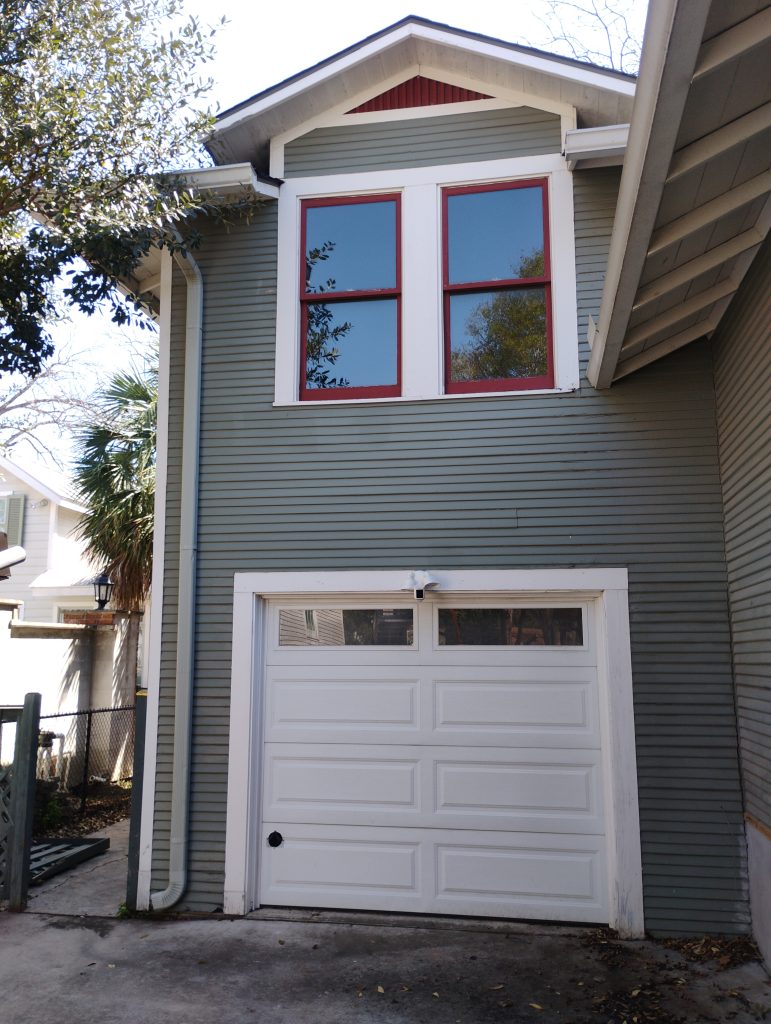
A garage door vibrates the room above because mechanical vibrations from steel rollers, standard chain-drive openers, and rigid ceiling-mounted hanging brackets transfer directly through structural floor joists. Upgrading to a DC-powered belt-drive opener, installing rubber vibration isolators, replacing worn steel rollers with high-grade nylon rollers, and ensuring proper spring balance stops this resonance.
SAFETY WARNING: Never attempt to adjust, wind, or release garage door counterbalance springs, lift cables, or bottom roller brackets yourself. These components remain under extreme mechanical tension and can snap without warning, causing catastrophic blunt-force injury or death. Always entrust spring balancing, track realignment, and structural opener mounting to a certified garage door professional.
What Causes Garage Door Noise to Transfer into Upstairs Rooms?
Carriage houses, garage apartments, and two-story homes with a finished room over the garage (FROG) frequently suffer from excessive sound and mechanical resonance. When an overhead door operates, every rotational click, roller chatter, and motor hum travels through physical connection points into the subfloor and drywall above.
1. Rigid Steel Hanging Brackets Bolted to Subfloor Joists
Most garage door openers and horizontal tracks are suspended using perforated angle iron lagged directly into the ceiling joists. When the opener motor hums or the door rolls along the track, those steel brackets act as tuning forks, conducting mechanical harmonics straight into the floor joists of the bedroom or office overhead.
2. High-Frequency Chain Drive and AC Motor Vibration
Older alternating current (AC) garage door openers run at full torque instantly, generating abrupt starting and stopping vibrations. Furthermore, metal chain-drive trolleys slap against steel rail assemblies, generating rhythmic thuds that resonate through building framing.
3. Worn Steel Rollers and Misaligned Tracks
Standard unsealed steel rollers develop play over time and slide rather than roll across the track seams. As metal wheels bounce across track joints and bends, they generate sharp impact vibrations that transmit directly into the structural framing.
Causes vs. Solutions for Overhead Door Noise Transfer
| Root Cause of Vibration | Symptom in Upstairs Living Space | Professional Remediation |
|---|---|---|
| Rigid opener motor bracket lag bolted to floor joist | Deep humming and buzzing sound felt through the floorboards | Install neoprene rubber vibration isolation kits between brackets and joists |
| Metal chain-drive opener mechanism | Jerking, rattling, and cyclic clanking overhead during operation | Upgrade to a steel-reinforced rubber belt-drive opener with a soft-start DC motor |
| Unsealed steel rollers running on dry metal track | Rumbling, scraping roar as the door travels along the horizontal tracks | Retrofit with 13-ball-bearing, precision-sealed nylon rollers |
| Door out of balance or improperly tensioned springs | Loud groaning sound and motor straining under heavy lifting load | Professional spring rebalancing and torque adjustment to relieve motor strain |
Bulleted Troubleshooting Checklist: Isolating the Sound
- Perform the Manual Release Test: Pull the red emergency release cord while the door is fully closed. Lift the door manually by hand. If the door feels excessively heavy or sticks, an unbalanced torsion system is forcing your motor to overwork, causing structural shaking.
- Inspect the Rollers: Check whether your door is riding on unbranded, all-metal rollers without ball bearings. Metal-on-metal friction generates the majority of horizontal track rumble.
- Listen to the Opener Motor: Place your hand safely on the drywall ceiling (away from moving parts) while the motor runs. A distinct, loud buzz indicates motor vibration traveling directly through the framing.
- Check Track Brackets: Ensure all track fasteners and ceiling hangars are tight; loose brackets vibrate against framing lumber, magnifying rattling.
Long-Term Upgrades for Quiet Operation
If you use the space above your garage as a bedroom, nursery, or office, replacing your system with modern sound-dampening components provides immediate relief. A DC-powered belt-drive motor with soft-start and soft-stop technology eliminates the abrupt jerks that shake ceiling joists. Pairing this with sealed nylon rollers and dedicated rubber isolator mounts isolates the garage system entirely, keeping the living space above peaceful and quiet.